
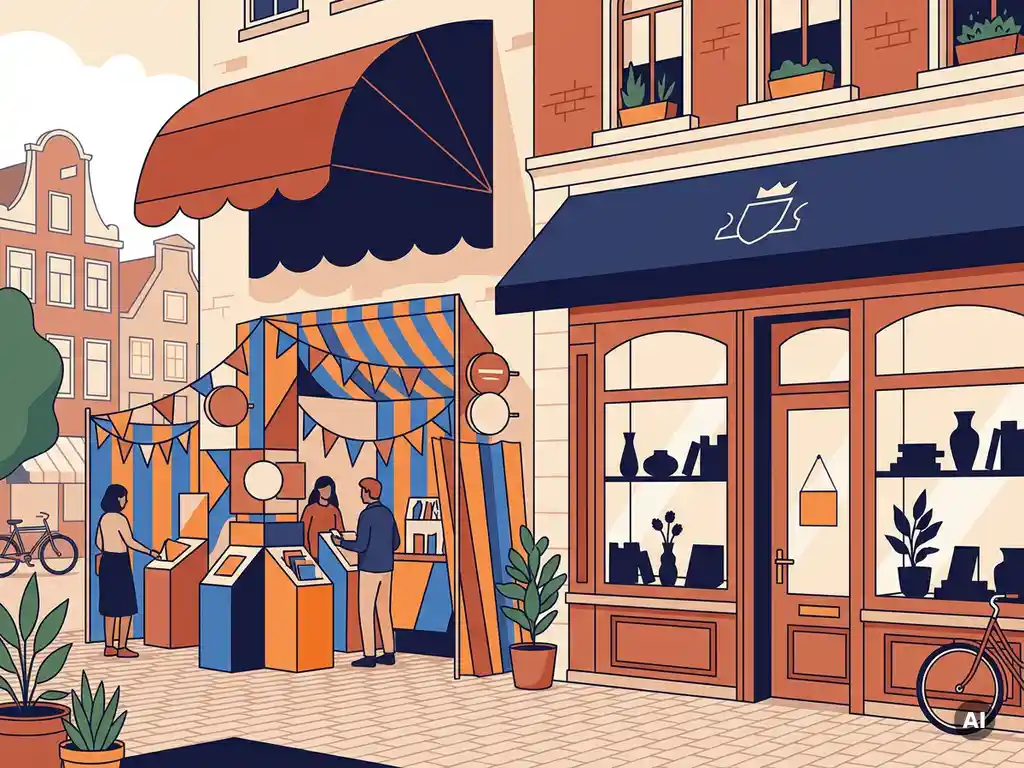
A pop-up store is a temporary retail space that you rent for a defined period, ranging from a few days to several months. A permanent retail space involves a long-term lease agreement, typically five years or more. The difference lies not only in the duration, but also in the costs, the lease terms, and the strategic use of the location.
For emerging retailers and growing brands, choosing between the two is one of the first and most defining decisions. The questions below help you make that choice on solid grounds.
When is a pop-up store the better choice?
A pop-up store is the better choice when you want to test a concept, location, or target audience without the financial and legal obligations of a long-term lease. It is also suitable for seasonal sales, product launches, or brand activations where presence at a specific moment holds more value than continuity.
Concrete situations in which a temporary retail space makes more sense than a permanent location:
- You run an online store and want to test the move to offline retail without five-year commitments
- You want to present a new product or collection around a specific period, such as the holidays or a trade fair
- You are considering multiple cities and want to first measure where your concept resonates best
- You have a limited starting budget and want to keep fixed costs low in the early stages
A pop-up store also offers brand value: the temporary nature creates urgency among consumers and attracts media attention in a way that a regular store rarely does. That makes it a strategic tool, not just a low-cost stepping stone.
What are the lease terms for a pop-up store versus a permanent retail space?
When renting a pop-up store, the lease terms are considerably more flexible than those of a permanent retail space. Temporary lease agreements run from a few days to a maximum of two years, carry no statutory tenant protection, and generally contain no break options or notice periods of several months. For a permanent retail space, a standard lease period of five years applies in the Netherlands, with tenant protection for the lessee.
The most important contractual differences at a glance:
- Duration: Pop-up: days to a maximum of 24 months. Permanent store: typically 5 or 10 years with option periods
- Tenant protection: Temporary lease agreements fall outside the regular tenant protection of the Dutch Civil Code, provided they are correctly drafted
- Termination: Pop-up contracts expire by operation of law on the agreed date. Permanent leases are subject to notice periods and judicial review
- Service charges: Permanent leases additionally include management costs, marketing contributions (in shopping centres), insurance, and maintenance
- Fit-out obligation: Permanent tenants are sometimes contractually required to meet a minimum fit-out standard or retail concept
It is advisable to always have a temporary lease agreement reviewed legally. A contract that is formally intended as temporary but does not meet the statutory requirements may still be classified as a regular lease, with all associated obligations.
How much does a pop-up store cost compared to a permanent retail space?
A pop-up store typically costs more per square metre per day or week than a permanent retail space, but the total investment is lower because you are not entering into long-term obligations. When renting a permanent retail space, you pay a lower rent per m² per year, but considerable additional costs are added that significantly increase the total occupancy cost.
What determines the costs of a temporary retail space:
- Location and footfall: a prime location on a busy shopping street costs more than a secondary location
- Period: rates are higher around the holidays or during events
- Surface area and condition of the space: a move-in ready space costs more than a shell unit
For a permanent retail space, service charges, any marketing contributions to the shopping centre, insurance, and maintenance obligations are added on top of the base rent. In shopping centres, the total rental burden can therefore end up 20 to 40 percent higher than the base rent suggests. For a starting entrepreneur, it is therefore essential to compare the total operating costs, not just the rent per m².
When renting retail space through KroesePaternotte, the market conformity of both the rent and the service charges is verified against current market data, so you pay based on what the market actually demands rather than on a quoted offer.
Which locations are available for pop-up stores in the Netherlands?
In 2026, pop-up stores are available in virtually all Dutch cities, from the major shopping streets in Amsterdam, Rotterdam, Utrecht, and The Hague to the city centres of medium-sized cities such as Groningen, Eindhoven, Arnhem, and Maastricht. Temporary retail space is offered through shopping centre managers, property owners, and specialised platforms, but the best supply often circulates outside public portals.
Types of locations suitable for a pop-up store:
- Vacant retail properties on shopping streets, where owners prefer temporary letting over prolonged vacancy
- Shopping centres with an active pop-up policy, offering temporary units as a supplement to the permanent tenant mix
- Market halls and food halls for food and lifestyle concepts
- Office or commercial properties that are temporarily available and lend themselves to showroom or experience concepts
An important point to note: listing portals do not show all available locations by far. Owners of the most sought-after prime locations often offer temporary space directly through their network. Through KroesePaternotte’s current listings, you gain access to locations that are not visible through public channels, in cities throughout the Netherlands.
How do you transition from a pop-up store to a permanent retail space?
The transition from a pop-up store to a permanent retail space goes most smoothly when you actively use the pop-up period to collect data: revenue figures per day and hour, customer profiles, conversion rates, and the relationship with the location. That data forms the foundation for a well-informed location choice and strengthens your negotiating position when entering into a permanent lease agreement.
Steps that structure the transition:
- Analyse the pop-up results at location level: does the concept perform better in high-footfall transit locations or in more destination-oriented streets?
- Define the desired location parameters for the permanent store: city, street, minimum footfall volume, surface area, and maximum rental burden
- Benchmark the rent against market-conforming rates per m² for the specific location type. Rents vary significantly by street, not just by city
- Negotiate lease terms: duration, break options, rent-free period, and indexation arrangements are all negotiable, but only if you know what is market-conform
- Have the contract reviewed before signing, including the service charges and any additional obligations
Many entrepreneurs underestimate how much room there is in the negotiation of a lease agreement. Owners are willing to make concessions on price, duration, or fit-out contribution, but only if the tenant comes to the table with market knowledge. KroesePaternotte holds lease contract data going back to 1984 and knows the current rents per street across the entire Dutch retail market. That makes the difference between signing based on gut feeling and signing based on facts.
Are you unsure whether you are ready for a permanent location, or do you want to know which cities and streets suit your concept? Get in touch for a no-obligation conversation.
Related Articles
- What is the outlook for retail real estate in the Netherlands?
- How do you assess the quality of a Dutch retail location?
- What are footfall trends on Dutch shopping streets?
- What is the difference between a solitaire retail object and a shopping centre?
- Should you invest in Dutch retail property in 2026?
- Should you buy or rent a retail property as a retailer?
- Why are more and more e-commerce brands still choosing a physical store?
- What is the role of footfall in Dutch retail property valuation?
- How does Utrecht compare to Amsterdam for retail investment?
- What are the legal pitfalls of a retail space lease agreement?