
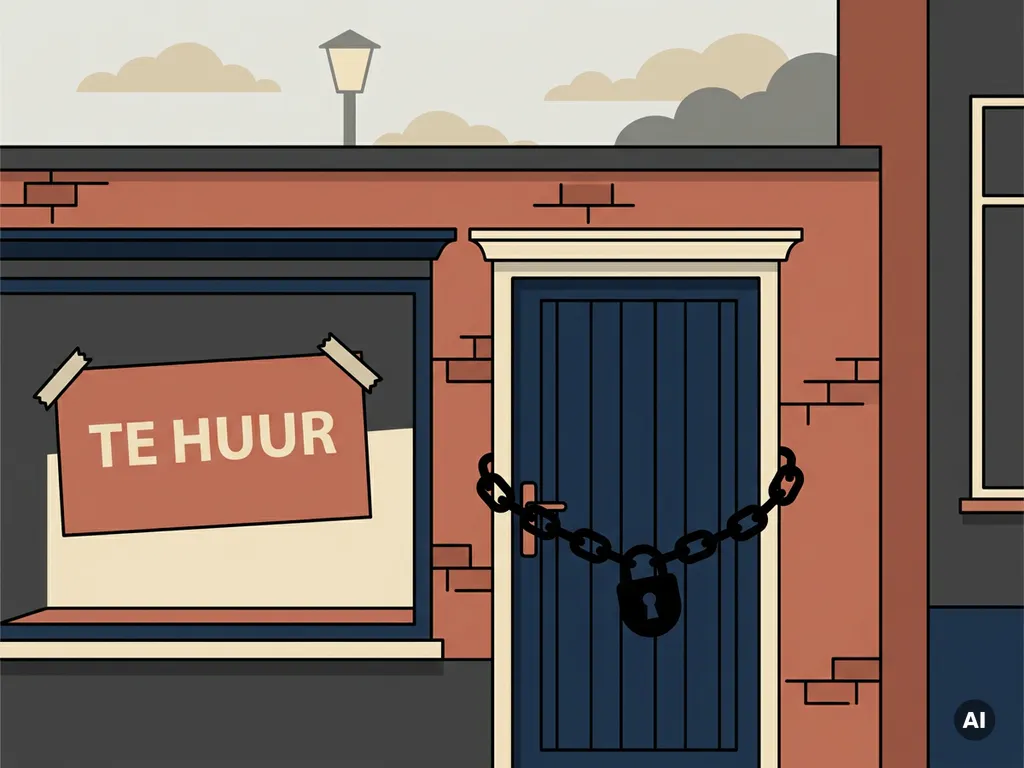
An excessively long lease term for a retail space carries real financial and operational risks. If revenue falls short, the market shifts, or your concept doesn’t work at the chosen location, you’re locked into an obligation that is difficult or costly to exit. The longer the term, the greater the exposure to those risks. The questions below provide direct answers, by topic, to what you as a retail entrepreneur need to know before you sign.
What happens if you want to close a store early?
If you want to vacate a retail space early without a contractual escape clause, you are in principle bound to the remaining lease period. In most cases, the landlord is entitled to continued rent payments until the end of the agreed term, unless another tenant is found or a settlement is reached. This is one of the biggest risks of an excessively long lease term.
In practice, there are three ways out, but none of them are free. First, you can look for a subtenant or successor who takes over your position, provided the landlord agrees. Second, you can negotiate a buyout with the landlord, which typically consists of a portion of the remaining rent. Third, you can pursue legal termination, but that requires demonstrable failure on the part of the landlord, which is rarely the case in an ordinary termination driven by business considerations.
The financial impact can be substantial. At a rent of, for example, €4,000 per month with two years remaining, you’re looking at a potential claim of nearly €100,000. For starting or growing retailers, that is an existential risk. It is therefore essential to carefully assess the lease term and the presence of a break option before you put pen to paper.
What is a reasonable term for a retail space lease?
In the Netherlands, the most common lease term for retail space is five years, with an option to renew for another five years. This is based on the legal framework of Article 7:292 of the Dutch Civil Code, which grants tenants of retail business premises a statutory minimum tenancy protection of two times five years. Shorter contracts are possible, but require judicial approval or a specific deviation arrangement.
Whether five years is reasonable depends heavily on your situation. For an established brand with a proven concept at a prime location in, for example, Utrecht, Rotterdam, or Amsterdam, five years is often acceptable. For an entrepreneur opening a physical point of sale for the first time, or an e-commerce brand making the move to offline, five years feels like a significant commitment. In that case, it is wise to negotiate a shorter initial period or a break option halfway through the term.
Landlords in strong retail streets rarely offer a shorter term of their own accord, because longer contracts increase their investment security. That makes the tenant’s negotiating position all the more important. Through guidance when renting retail space from a specialized retail real estate agent, you as a tenant can sit more firmly at the table, even when facing professional landlords.
What is a break option and when is it mandatory?
A break option is a contractual clause that gives the tenant the right to terminate the lease at a predetermined point during the term, typically after two or three years, subject to a notice period of six to twelve months. A break option is not legally required in the Netherlands; it is a negotiable contract element that protects the tenant against an excessively long lease term.
In practice, a break option is more frequently included as market conditions become more uncertain, or when a tenant has a less proven track record. Landlords sometimes accept a break option in exchange for a higher initial rent or a start-up period with reduced rent, the so-called rent-free period. It is a give-and-take in which both parties concede something.
When is a break option particularly relevant? Consider the following situations:
- You are opening your first physical store and don’t yet know whether the concept works at the chosen location
- You are in a rapidly changing market, such as fashion or consumer electronics
- The location is attractive but still developing, with uncertainty about foot traffic
- Your business plan anticipates growth into a larger space within three to four years
The absence of a break option in a long-term contract is one of the most common mistakes in the retail lease risk journey. Always make sure this point is explicitly included in the negotiation, even if the landlord indicates that it is “not standard practice.”
How does a long lease term affect the rent at review?
With a long lease term for retail space, the rent is typically indexed annually based on the consumer price index (CPI). After the initial contract period of five years, the landlord has the right to request a rent review based on the market rent. If the market has risen significantly during that period, the rent can increase substantially. The reverse also applies: in a declining market, a tenant can request a reduction.
A long lease term theoretically protects the tenant against interim market increases, but also ties them to a price that, in the event of disappointing results, is no longer proportionate to revenue. This is an essential aspect of lease risks for retailers: the rent burden as a percentage of revenue can become unbalanced over time.
At a review after five years, comparable rents in the area are examined — the so-called reference transactions. KroesePaternotte holds lease data for virtually the entire Dutch retail market, going back to 1984. That historical depth makes it possible to precisely substantiate what is market-conforming at a rent review, per street and per location type, throughout the Netherlands. That is a concrete advantage in negotiations or in the event of a potential judicial rent assessment.
When is a long lease term actually the better choice?
A long lease term is the better choice when the location is strategically strong, the rent is market-conforming or favorable, and your business model is stable enough to carry the obligation. In that case, a longer term provides certainty about the location and protection against the risk that the landlord will not renew the contract after five years or will offer the space to another tenant.
Concretely, there are situations in which a longer term is rational:
- You have invested in a specific fit-out or renovation that will only be recouped after several years
- The location is scarce and difficult to replace, such as a corner unit on a busy retail street in Groningen or The Hague
- The landlord offers a rent-free period or lower initial rent in exchange for a longer term
- You are working with a franchisor who requires a minimum contract duration
The core of the consideration is always: does the certainty of the location outweigh the flexibility you give up? That is not a question to be answered on the basis of gut feeling. It requires insight into the local market, rent price developments, and the quality of the location relative to alternatives.
For retailers who want to make that assessment properly, independent advice from a specialized party is not a luxury but a necessity. KroesePaternotte guides retailers daily through exactly these decisions, from assessing lease terms to negotiating break options and rents at prime locations throughout the Netherlands. Get in touch via the contact page to discuss what your situation requires, or view the current retail space listings to see which locations are available.
Related Articles
- What is the ROZ rental agreement and what does it mean for you as a tenant?
- What does a pop-up retail space in a busy shopping street cost?
- What is an anchor tenant in Dutch retail real estate?
- What is the outlook for retail real estate in the Netherlands?
- How do interest rates affect Dutch retail property yields?
- How does Dutch lease law affect retail real estate investors?
- What is indexation in a Dutch retail lease?
- How large is the vacancy rate in Dutch shopping streets?
- Why is location grade the most important factor in Dutch retail investment?