
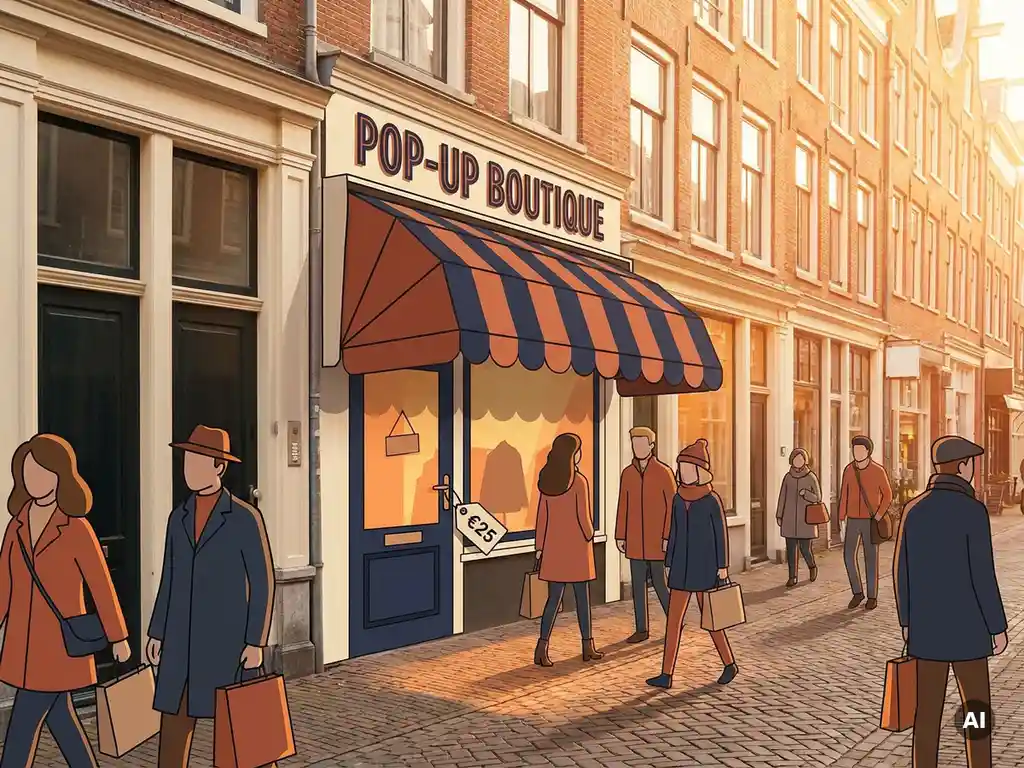
A pop-up retail space in a busy shopping street costs on average between €80 and €250 per m² per month, depending on the city, the street, and the lease duration. At the most prime locations in Amsterdam or Rotterdam, monthly prices for temporary spaces can go even higher. The shorter the rental period, the higher the price per m² tends to be. The questions below help you understand what determines that price, what additional costs come on top, and when a pop-up store is financially worthwhile.
What determines the rental price of a pop-up retail space?
The rental price of a temporary retail space is primarily determined by location, duration, and availability. A pop-up on a prime A1 shopping street with high foot traffic costs considerably more than a space in a secondary location or in a city centre outside the major metropolitan areas. The shorter the desired rental period, the more the landlord factors a risk premium into the price per m².
In addition to location and duration, the following factors play a role:
- Floor area: Smaller spaces typically have a higher price per m² than larger units.
- Condition of the space: A fully fitted pop-up space (with lighting, flooring, and shopfront display) costs more than a bare shell unit.
- Season and timing: Around the holidays or during events, demand increases, and with it the price.
- Vacancy on the street: Landlords with long-term vacant properties are sometimes willing to be more flexible on price to keep the location active.
Understanding what is market-conform per street and per city is crucial. Without that knowledge, it is difficult to assess whether an offer is realistic. Guidance on renting retail space from a specialised retail agent gives you direct access to current rental price data per location.
What are the average costs per m² in busy shopping streets?
In 2026, rental prices for pop-up retail space in busy shopping streets range roughly between €80 and €250 per m² per month for temporary leases. At the most prime locations, such as the Kalverstraat in Amsterdam or the Lijnbaan in Rotterdam, short-term pop-up contracts can exceed that range. In mid-sized cities such as Groningen, Eindhoven, or Arnhem, rates are considerably lower.
For comparison: standard annual rental prices on the same streets are typically expressed in euros per m² per year. A pop-up rental price per month can, when converted, be two to three times higher than the annual equivalent, because the landlord prices in flexibility and vacancy risk.
Some indicative benchmarks by location type:
- A1 locations in major cities (Amsterdam, Rotterdam, Den Haag): €150 to €250+ per m² per month for pop-up
- A locations in mid-sized cities (Utrecht, Eindhoven, Groningen): €80 to €150 per m² per month
- B locations and shopping centres: €40 to €80 per m² per month
These are indicative ranges. The actual price always depends on the specific space and the timing of the rental.
What additional costs come on top of the base rental price?
In addition to the base rent, as a pop-up tenant you will almost always pay service charges, energy costs, and a security deposit. In some cases, fit-out costs, permit fees, or a contribution to the marketing activities of the shopping area are added on top. The total actual costs are therefore structurally higher than the base rental price suggests.
The most common additional costs are:
- Service charges: For cleaning, security, management, and shared facilities. Depending on the location, this can amount to 10 to 25 percent of the base rent.
- Energy costs: For pop-up spaces, gas, water, and electricity are sometimes charged separately or included in an all-in price. Always verify this in advance.
- Security deposit: Landlords frequently require a deposit of one to three months’ rent for short-term leases, depending on the duration and risk profile.
- Fit-out costs: Shell spaces require investment in flooring, lighting, and display furniture. Some landlords offer fitted pop-up spaces at a higher rental price.
- Permits: Certain activities or exterior signage require municipal permits, with associated costs and lead times.
How does a pop-up lease differ from a standard lease agreement?
A pop-up lease is a short-term, flexible rental agreement that is legally structured differently from a standard retail lease. Standard retail lease agreements in the Netherlands fall under the protection of Article 7:290 of the Dutch Civil Code, with minimum terms of five plus five years and strict termination rules. Pop-up contracts are typically concluded outside this rental regime, through a so-called right of use or a short-term lease agreement that gives both parties more freedom.
The key differences at a glance:
- Duration: Pop-up contracts run from one week to a maximum of a few months. Standard lease agreements start at a minimum of five years.
- Tenant protection: With a pop-up arrangement, the tenant has no or limited statutory tenant protection. This gives the landlord more flexibility, but also provides the tenant with less security.
- Notice period: In pop-up contracts, notice periods are short, sometimes only a few weeks. This makes it easier to exit quickly.
- Break options: Standard contracts sometimes include break options after three years; with pop-up leases, the duration itself is already the exit.
- Rent indexation: For short-term pop-up contracts, indexation generally does not apply.
Always have a pop-up lease reviewed before signing. The legal approach varies by landlord, and not every contract offered as a “pop-up” is actually structured outside the standard rental regime.
When is a pop-up store financially attractive?
A pop-up store is financially attractive when the expected revenue or brand value outweighs the higher rental price per m² and the additional costs. Because the monthly rental price for pop-up spaces is higher than for long-term contracts, the short-term presence must serve a clear purpose: seasonal sales, product launch, brand activation, or location testing.
Pop-up stores are financially most attractive in the following situations:
- You want to test a new city or street without entering into long-term commitments.
- You have a seasonal product or collection with a clear peak period (summer, holidays).
- Your brand is already proven online and you want to validate the step to physical retail with minimal risk.
- You want to build brand awareness at a prime location that you cannot sustainably afford.
- You are filling a temporarily vacant property on a desired street, where the landlord is willing to accept a lower price to avoid vacancy.
A pop-up is financially unwise when the costs are too high relative to the expected revenue, or when you actually need a permanent location but are treating the pop-up as a cheaper intermediate step. In that case, you will ultimately pay more than if you had signed a standard lease directly.
How do you negotiate the rental price of a pop-up location?
Negotiating a pop-up rental price effectively starts with knowledge of the market-conform price on that specific street. Those who know what comparable spaces at the same location cost are in a stronger position at the negotiating table. Without that reference data, you negotiate on instinct, and that rarely works in the tenant’s favour.
Practical negotiation tips for pop-up leases:
- Ask about the vacancy duration: A property that has been vacant for a long time gives you negotiating leverage. Landlords prefer a temporary tenant over an empty shopfront.
- Negotiate on the total price: In addition to the base rent, you can also negotiate on service charges, the security deposit, and the fit-out.
- Offer certainty: An upfront payment or a short but clearly structured contract can tip a landlord in your favour.
- Be flexible on timing: If you are willing to rent during a less popular period (outside peak season), you have more room to negotiate on price.
- Know your alternatives: If you have multiple locations in mind, you are in a stronger position. Landlords notice when a tenant has no alternative.
For entrepreneurs looking for a pop-up space for the first time, engaging a specialised retail agent is often the smartest move. KroesePaternotte holds lease contract data going back to 1984 and covering virtually the entire Dutch retail market. This makes it possible to assess precisely whether an offer is market-conform and to negotiate based on facts, not gut feeling. Many of the best pop-up locations are never publicly listed either. Through the network of KroesePaternotte, you also have access to that off-market supply.
Want to know what a pop-up retail space in your desired city or street realistically costs? Browse the current retail space listings or get in touch directly via contact for a market-conform assessment of your location requirements.
Related Articles
- How do you know if service charges for retail space are reasonable?
- How does a retail property valuation work in the Netherlands?
- Why are more and more e-commerce brands still choosing a physical store?
- What is the difference between high street and shopping centre investment?
- What are footfall trends on Dutch shopping streets?
- How do location grades affect retail property pricing in the Netherlands?
- What drives rental income on retail property in the Netherlands?