
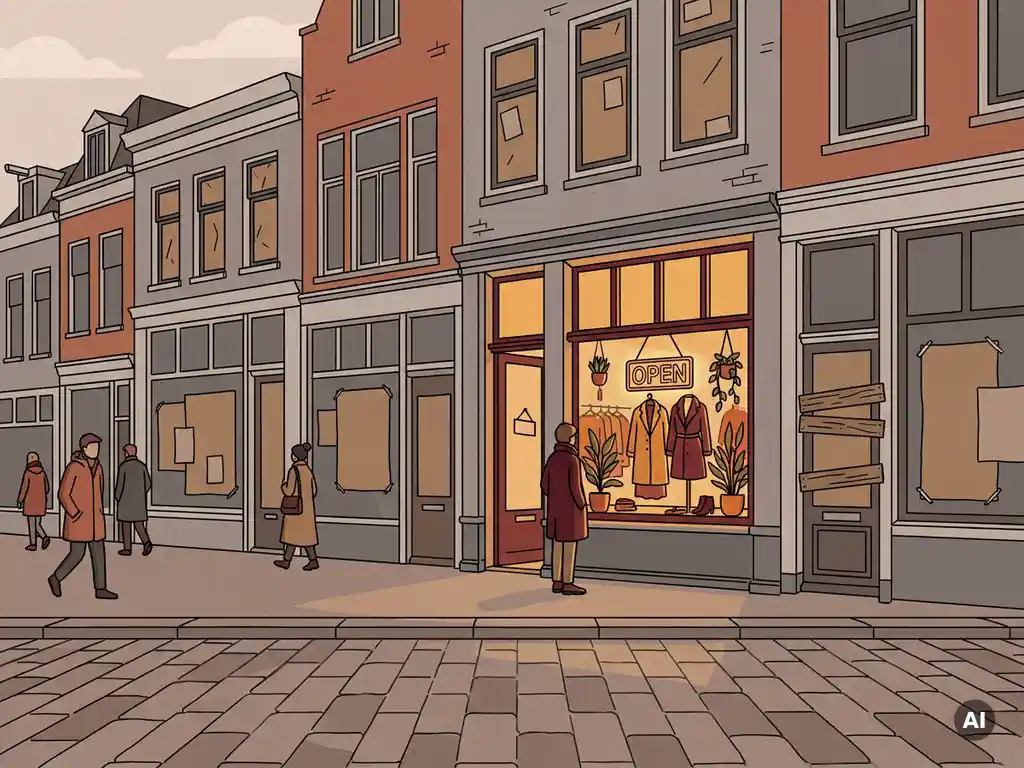
Retail vacancy rates in Dutch shopping streets average between 7 and 10 percent of total retail floor space in 2026, depending on the type of location and region. City centres of major cities perform better than medium-sized cities and peripheral retail areas, where vacancy rates can be considerably higher. The figures have stabilised in recent years following a peak during the COVID-19 period, but the situation varies significantly by location. In this article, we answer the most frequently asked questions about retail vacancy in the Netherlands.
Which cities have the highest retail vacancy rates?
Medium-sized cities such as Heerlen, Lelystad, Almelo and Terneuzen structurally have the highest retail vacancy rates in the Netherlands. In some of these cities, the vacancy rate rises to 20 percent or more. The major cities of Amsterdam, Utrecht, Rotterdam and The Hague present a far more favourable picture, particularly at prime locations in the city centre where demand for retail space still exceeds supply.
The explanation lies in the combination of population size, purchasing power and the appeal to national and international retailers. A city like Amsterdam attracts retailers from around the world, while a medium-sized city in the periphery is increasingly unable to attract the same tenants. Vacancy also concentrates within cities: even in Rotterdam or The Hague there are side streets and secondary retail areas where vacancy rates are considerably higher than the urban average.
For entrepreneurs looking for retail space, the distinction between prime, secondary and tertiary locations within a city is at least as relevant as the difference between cities. View the current retail listings to get an idea of what is available per location type.
How is retail vacancy measured and tracked?
Retail vacancy is measured by dividing the number of vacant retail units or the vacant retail floor space in square metres by the total available retail floor space in an area. This produces a vacancy rate that can be calculated per street, per city or at national level. Market parties, municipalities and research agencies use their own counts and registrations for this purpose.
In practice, vacancy figures are tracked through field research, where staff physically survey shopping streets, supplemented by data from property registrations and lease contract information. The reliability of vacancy figures depends heavily on the currency and completeness of the underlying data. Public portals do not always reflect the actual market situation: properties are sometimes registered as available while they have already been let, or vice versa.
KroesePaternotte holds a database going back to 1984 that contains lease contract data covering virtually the entire Dutch retail market. This historical depth makes it possible to analyse vacancy trends over longer periods and to identify location-specific trends that are not visible in public figures.
What are the main causes of vacancy in shopping streets?
The main causes of vacancy in shopping streets are the structural growth of online shopping, oversupply of retail floor space, demographic decline in certain regions and a mismatch between the asking rents and what retailers are willing to pay. These factors reinforce each other and make vacancy a persistent problem in many areas.
The Netherlands has been adding new retail floor space for decades, even during periods when the retail sector was already under pressure. The result is a structural oversupply in many medium-sized cities and peripheral locations. At the same time, the rise of e-commerce has meant that part of physical retail is simply no longer viable at locations with limited footfall.
Another cause that is less visible but nonetheless a factor: landlords who hold on to rents that are no longer in line with the market. A property that stands vacant because the landlord is unwilling to adjust the rent to current market reality counts as vacancy but is in fact a negotiation problem. This is one of the reasons why knowledge of current rents per street and per city is so valuable when searching for retail space.
Does vacancy differ between shopping centres and city-centre shopping streets?
Yes, there is a clear difference. City-centre shopping streets at prime locations in major cities structurally have low vacancy, while shopping centres outside the city centre and in particular older, large-scale centres in medium-sized cities show higher and sometimes rising vacancy. The type of location and the market position of the centre are determining factors.
Dominant shopping centres with strong drawing power, such as large covered centres in regional capitals, generally perform well. They offer a combination of retail, hospitality and amenities that attracts visitors. But shopping centres built in the 1980s and 1990s, without sufficient differentiation or redevelopment potential, struggle with structural vacancy that is difficult to resolve without fundamental adjustment of the concept or the property itself.
City-centre shopping streets benefit from their location, historical appeal and the combination with hospitality and culture. Yet the same applies here: the prime location performs, the secondary location is under pressure. The difference between a busy main street and a side street a hundred metres away can be enormous in vacancy terms.
What happens to long-term vacant retail properties?
Long-term vacant retail properties are increasingly being converted to other uses, such as housing, offices, hospitality or community facilities. Municipalities play an active role in this through zoning plan changes and transformation programmes. Properties that have been vacant for more than two years are actively approached for repurposing in many municipalities.
The transformation of retail space into housing has become a deliberate choice in many city centres. It reduces the oversupply of retail floor space, adds homes in a tight market and can contribute to a more vibrant city centre by adding more residents to the area. At the same time, this reduces the total retail floor space, which in time can contribute to a healthier balance between supply and demand.
For retailers who are looking for space, this offers an interesting perspective: the total supply of traditional retail space is decreasing in some cities, which can increase pressure on good locations. Those who want to secure a strong location would do well not to look only at what is publicly available. Guidance on renting retail space provides access to locations that never appear on public portals.
Is retail vacancy in the Netherlands increasing or decreasing?
Retail vacancy in the Netherlands has declined or stabilised at many prime locations following the peak during the COVID-19 period. At secondary and tertiary locations and in medium-sized cities, however, vacancy remains structurally high and in some cases continues to rise. The picture is therefore twofold: the strongest locations are recovering, the weaker locations are lagging behind.
This polarisation is one of the most striking trends in the Dutch retail market in recent years. Retailers are increasingly concentrating on a limited number of top locations in major cities, keeping demand for those locations high and rents at prime locations stable. At the same time, demand for secondary and tertiary locations in smaller cities is structurally disappearing.
For entrepreneurs looking for retail space, this is a relevant fact. The best locations are scarce and are let quickly, often before they are publicly offered. Those who want to compete for those spaces need up-to-date market knowledge and direct contacts with owners and developers. KroesePaternotte is active as a specialist retail agent on exactly that market every day, in Amsterdam but also in Groningen, Rotterdam, Utrecht and the rest of the Netherlands.
Would you like to know what is available at the location most suited to your concept? Get in touch for a no-obligation conversation about the possibilities.
Related Articles
- What does a retail property agent do differently from a regular estate agent?
- What are the strongest secondary retail cities in the Netherlands?
- When do you need a valuation of retail property?
- What is the role of footfall in Dutch retail property valuation?
- What is the Kalverstraat and why is it a prime retail street?
- What is the difference between gross and net rental yield in Dutch retail?
- Should international investors buy Dutch retail real estate in 2026?
- How do you conduct due diligence on a Dutch retail property?