
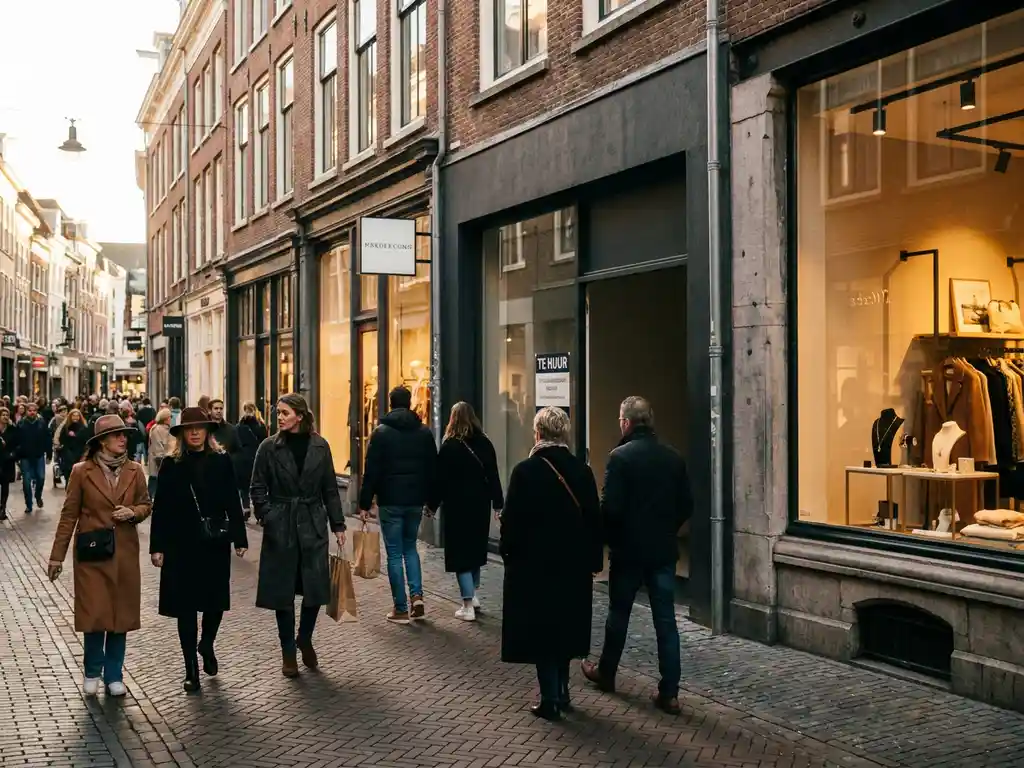
Rental growth in Dutch retail real estate is driven primarily by location quality, tenant demand, and the structural scarcity of prime retail space in the Netherlands’ strongest trading streets and shopping centres. In markets like Amsterdam’s PC Hooftstraat or the main pedestrian zones of Utrecht and Rotterdam, limited supply and sustained occupier demand create upward pressure on rents. For investors, understanding what separates a location with genuine rental growth potential from one facing structural decline is the critical question — and the answer is highly local.
Which locations in the Netherlands see the strongest rent growth?
Prime high street locations in the Netherlands’ major cities consistently see the strongest rental growth. Amsterdam’s top shopping streets, the main retail zones of Utrecht, Rotterdam, The Hague, and Eindhoven, and well-anchored, dominant regional shopping centres all outperform. The key driver is not city size alone, but the concentration of footfall and the absence of credible competing retail destinations nearby.
Within any given city, the difference between an A1 location and a B-location can be dramatic. An A1 position — typically the highest-footfall stretch of a primary shopping street — commands significantly higher rents and retains occupier demand even when broader market conditions soften. A B-location in the same city may face sustained vacancy pressure and declining rental values, even as the nearby A1 street performs well.
This granularity matters enormously for investors. National or even city-level averages can obscure what is actually happening at street level. Reliable intelligence on which specific streets and centres are genuinely performing requires current leasing data and active market presence — not just macro statistics. KroesePaternotte’s retail market research draws on lease contract data going back to 1984, covering virtually the entire Dutch retail market, which makes location-level rent analysis both historically grounded and current.
What retail formats are driving rent increases right now?
In 2026, the formats driving rent increases in the Netherlands are prime high street units in dominant city centres, standalone supermarkets, and food and beverage-anchored retail in well-visited locations. Supermarkets in particular have proven highly resilient, with strong operator covenants and long lease terms that support stable and growing rental income. Food and experience-led retail has also strengthened its position as a footfall driver in shopping centres.
Conversely, mid-market fashion and discretionary retail in secondary locations has faced structural pressure. The formats performing best share a common characteristic: they serve needs that cannot be easily replicated online. Grocery, food service, health and beauty, and experiential concepts all fall into this category. International retailers entering or expanding in the Dutch market — including premium and lifestyle brands — continue to target A1 high street positions, which sustains competition for space and supports rents at the top of the market.
How does the huurprijsherziening process affect rental values?
The huurprijsherziening is the Dutch statutory market rent review process, governed by Article 7:303 of the Dutch Civil Code. It allows either landlord or tenant to request a rent adjustment to the prevailing market level every five years. This mechanism means that Dutch retail rents are periodically anchored to actual market evidence — which can work in favour of landlords in strong locations and against them in weaker ones.
For investors, the huurprijsherziening process has direct implications for asset valuation and income forecasting. If a property is currently let at a rent significantly above current market levels — a situation known as being overhuurde — the next rent review cycle creates a real risk of downward adjustment. Equally, a property let below market in a strong location may represent an opportunity for upward reversion.
Assessing this correctly requires knowing what comparable leases have actually transacted at, not just asking rents or headline figures. This is where access to a comprehensive lease database becomes decisive. KroesePaternotte’s valuation and rent review advisory is built on precisely this kind of transactional evidence, and the firm handles rent reviews for major institutional landlords and financing banks across the Netherlands.
What is the relationship between consumer spending and retail rents in the Netherlands?
Consumer spending is one of the primary demand-side drivers of retail rents in the Netherlands. When household purchasing power rises and consumer confidence is strong, retail sales volumes increase, occupier demand for space strengthens, and landlords gain pricing power. When consumer spending contracts, the reverse follows — vacancy rises in weaker locations, and tenants gain leverage in lease negotiations.
The Netherlands benefits from a structurally strong consumer base: high household income levels, low unemployment relative to European peers, and a dense, urbanised population that supports consistent retail footfall. These fundamentals underpin the Dutch retail real estate market’s appeal to international investors. However, consumer spending growth does not translate uniformly into rent growth across all locations. Prime streets in cities with strong employment and tourism capture spending disproportionately, while peripheral or secondary locations see much weaker pass-through from macro growth to rental income.
How does online retail growth affect Dutch retail rents?
Online retail growth has reshaped but not eliminated demand for physical retail space in the Netherlands. E-commerce penetration in the Dutch market is among the highest in Europe, which has accelerated the structural decline of certain retail formats and locations — particularly mid-market fashion in secondary streets and retail parks without strong anchors. However, it has not undermined demand for prime physical space; in many cases, it has concentrated it.
Retailers operating successfully in the Netherlands increasingly use physical stores as brand and experience touchpoints rather than purely transactional locations. This shifts the profile of tenants competing for A1 space toward brands with strong identities and omnichannel strategies. The result is that prime high street vacancy in the Netherlands’ major cities remains low, and rents in those locations have held or grown, even as e-commerce has expanded.
The impact of online retail is therefore most visible in Dutch shopping street vacancy rates in secondary and tertiary locations, where weaker retailers have exited and not been replaced. Investors should distinguish sharply between these structural losers and the prime locations where physical retail continues to command strong occupier demand.
What should investors look at to assess future rent growth potential?
Investors assessing future rental growth potential in Dutch retail real estate should focus on six core factors: location quality within the catchment hierarchy, current vacancy and footfall trends at street level, tenant covenant strength and lease expiry profile, the gap between passing rent and current market rent, the presence and quality of anchor tenants, and the supply pipeline of competing retail space in the catchment.
- Location hierarchy: Is the asset in an A1 position within a dominant retail destination, or in a secondary location vulnerable to structural decline?
- Footfall and vacancy trends: Are vacancy rates in the immediate area stable, falling, or rising? Is footfall supported by anchors, transit, or tourism?
- Lease structure and reversion: What is the gap between passing rent and market rent? When does the next huurprijsherziening window open?
- Tenant quality: Are existing tenants financially strong, expanding operators, or structurally challenged retailers?
- Anchor presence: Does the asset or its immediate retail environment benefit from a strong anchor — a supermarket, a department store equivalent, or a dominant food offer?
- Supply constraints: Is new competing retail space being developed nearby? In most Dutch city centres, planning restrictions and limited land availability keep supply tight.
Getting these answers right requires more than reading a market report. It requires current, granular intelligence on what leases are actually transacting at, which retailers are actively seeking space, and what the realistic re-letting prospects are for a given unit. KroesePaternotte’s retail investment advisory integrates leasing, valuation, and research expertise into a single advisory offering — giving investors access to live market intelligence across all major Dutch cities and retail formats.
For international fund managers evaluating the Dutch retail market as part of a broader European strategy, the right local partner is not a generalist with a retail desk. It is a firm that has been exclusively focused on Dutch retail real estate since 1984, has transacted across every major format, and holds the most comprehensive lease database in the market. Learn more about KroesePaternotte’s approach or explore the investment advisory service to understand how local expertise translates into better acquisition decisions.
Related Articles
- What does a retail property agent do differently from a regular estate agent?
- What is an A1 location in the Netherlands?
- What are the benefits of a pop-up shop as a first step offline?
- What is the difference between a pop-up store and a permanent retail space?
- What is the Kalverstraat and why is it a prime retail street?
- How do Dutch retail property yields compare to other asset classes?
- Renting a small retail space in the city center: what should you look out for?