
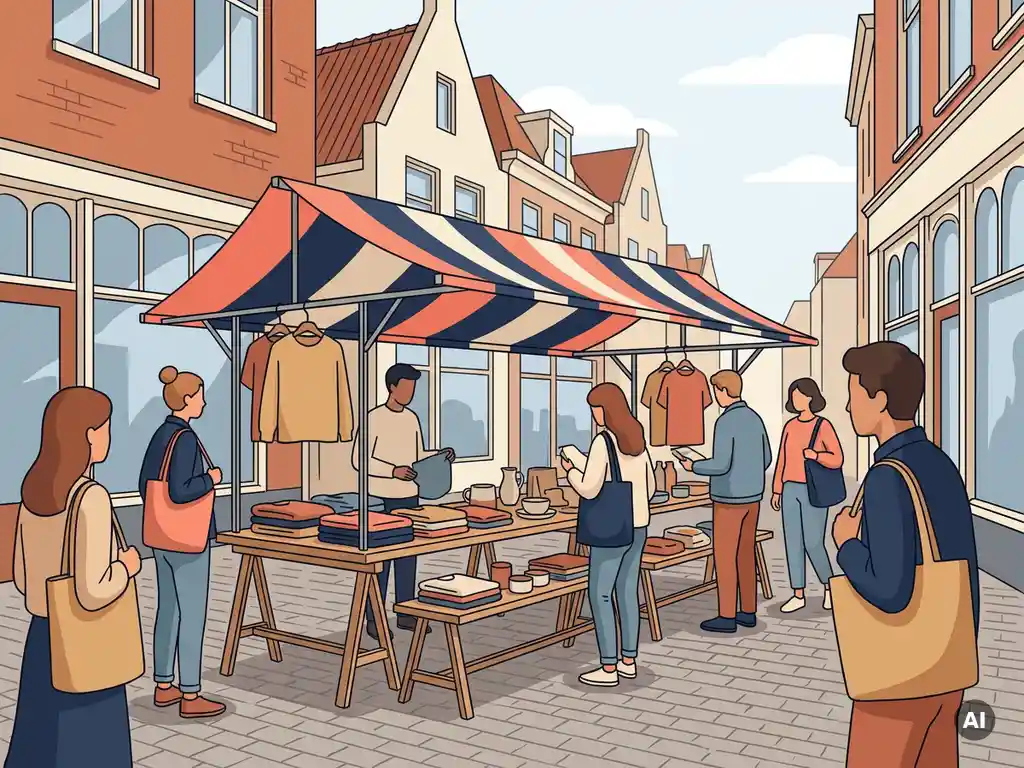
A pop-up store is for many entrepreneurs the smartest first step offline: you test a physical location without committing to a long-term lease, with limited startup capital and maximum flexibility. That makes the model particularly suitable for e-commerce brands looking to make the transition to a physical retail point, or for new retailers who want to validate their concept before opening a permanent location. The questions below help you understand what a pop-up store actually costs in practice, how the contracts work, and how to find the right location.
What does a pop-up store cost on average per month?
The monthly costs of a temporary retail space vary widely, depending on the city, the location within that city, and the duration of the lease. On a busy shopping street in Amsterdam or Utrecht, you can easily pay between €3,000 and €8,000 per month for a small pop-up space of 50 to 100 m². In mid-sized cities such as Groningen, Arnhem, or Tilburg, those figures are considerably lower, often between €1,500 and €4,000 per month for comparable spaces.
In addition to the base rent, there are almost always additional costs. Think of service charges for the management and cleaning of common areas, energy costs, and sometimes a contribution to the marketing activities of a shopping centre. For pop-up concepts in shopping centres, a turnover-related rent component is also regularly agreed upon: you pay a base rent plus a percentage of your revenue. This lowers the threshold, but does require good administration.
Keep in mind that short-term lease agreements inherently carry a higher price per month than long-term contracts. Landlords compensate for vacancy risks and higher administrative burdens in the price. Knowing what a market-conform rent is for a specific street puts you in a much stronger negotiating position.
How does a pop-up lease contract differ from a regular retail contract?
A pop-up lease contract is a short-term rental agreement, typically for a period of one week up to a maximum of twelve months. It differs from a regular retail contract in three essential ways: the duration, the legal protection, and the flexibility upon termination.
A regular lease contract for retail space falls under Dutch tenancy law for business premises (Article 7:290 of the Dutch Civil Code) and provides the tenant with strong protection, including a minimum lease term of five years and a statutory right to lease renewal. A pop-up contract is often concluded as a short-term agreement outside this regime, which is legally possible provided both parties explicitly deviate from the statutory protective provisions. This gives landlords more freedom to reclaim the property, but offers you as the tenant less long-term security.
In practical terms, this means that with a pop-up contract you can enter and exit more quickly, but you also have less room to enforce modifications to the property or invoke rent price protection. Always have a pop-up contract reviewed by someone with knowledge of retail real estate before signing, especially if the term is longer than three months or if there is a contribution to renovation costs involved.
Which locations are most suitable for a pop-up store?
The most suitable locations for a pop-up store are places with high foot traffic, visibility, and an audience that matches your target group. These are not necessarily the most expensive prime locations in a city centre. Depending on your concept, up-and-coming shopping streets, market halls, shopping centres with vacancies, or temporarily available corner units in residential neighbourhoods can also work excellently.
Shopping centres are increasingly offering pop-up concepts active space, precisely because temporary tenants visibly fill vacancies and attract visitors. This gives you as an entrepreneur negotiating room: the landlord also has an interest in your presence. City centres in mid-sized cities such as Zwolle, Breda, or Den Bosch also offer lower rents at comparable foot traffic numbers compared to the major cities.
When choosing a location, look beyond the rent per square metre. Accessibility, ease of parking, neighbouring stores, and the demographic composition of the area all partly determine whether your concept succeeds. A pop-up store for a premium brand performs better in an environment with related brands than in a cheap but rarely visited location.
How do you use a pop-up store to test whether a location is profitable?
A pop-up store is only a good test if you determine in advance which measurable criteria the location must meet. Set concrete goals: how many visitors do you expect per day, what is your average transaction value, and what revenue is needed to cover the rental costs plus operational costs? Without that benchmark, you measure nothing meaningful.
During the pop-up period, record at least the following data:
- Daily foot traffic in and in front of the store
- Conversion rate: how many visitors actually make a purchase
- Average order value and total revenue per week
- Origin of customers: are they passing by or actively seeking out the store
- Customer feedback about the location itself
Compare these results with your pre-set goals and with the performance of your online channels during the same period. A location is profitable if the margin after deducting rent, staff, and other costs is positive, or if the brand awareness and customer acquisition represent a value that outweighs the costs. The latter is harder to measure, but certainly relevant for brands that deliberately invest in offline visibility.
When is a pop-up store not a good choice?
A pop-up store is not a good choice if your concept depends on returning customers who know where to find you, if your product requires a lengthy purchase consideration, or if the setup and fit-out costs are so high that a short duration will never recoup them.
Specific situations in which a pop-up works less well:
- Service-intensive concepts: Custom work, repairs, or advice requiring multiple visits thrives poorly in a temporary setting without a fixed customer base.
- Heavy fit-out investments: If you invest €20,000 or more in a store interior, a two-month contract is financially irresponsible.
- Logistical complexity: Concepts with large inventories, refrigeration units, or special technical requirements are difficult to set up and dismantle quickly.
- Brand positioning focused on stability: For some target audiences, a temporary location signals uncertainty rather than exclusivity.
In those cases, it is wiser to look directly for a short-term but regular lease contract of one to two years, so that you can seriously build up the location without the drawbacks of too short a duration.
How do you find available pop-up spaces that are not listed online?
Many of the best pop-up locations are never listed on public property portals. Landlords and shopping centre managers prefer to rent temporary spaces directly to known parties or through agents, because the selection process for short-term contracts would otherwise become too labour-intensive. Those who only search on Funda or ilocate therefore see a limited and often already outdated supply.
The most effective ways to access non-public listings:
- Network directly with shopping centre managers. They actively manage vacancies and are open to temporary occupancy, especially if your concept fits the profile of the centre.
- Approach owners of vacant properties directly. A land registry check or a walk through a shopping street gives you names and addresses you can follow up on.
- Engage a specialised retail agent. Renting retail space through a specialist gives you access to listings that become available through direct relationships with owners and developers, long before they are publicly listed.
KroesePaternotte has daily contact with owners, developers, and shopping centre managers throughout the Netherlands, from Amsterdam to Groningen. That network, built since 1984, provides access to available retail spaces that remain outside the regular portals. For an entrepreneur looking to open their first physical store in a good location, that difference is decisive. Want to know what is available in your desired city or street? Get in touch and discuss your search directly with a retail specialist.
Related Articles
- What does it cost to hire a retail broker?
- How do you finance the opening of a new retail location?
- What is a 303 valuation in the Netherlands?
- Why does anchor tenant quality matter for retail investors?
- How do interest rates affect Dutch retail property yields?
- Can you improve retail property returns by repositioning a Dutch asset?
- What are typical retail property yields in the Netherlands in 2026?