
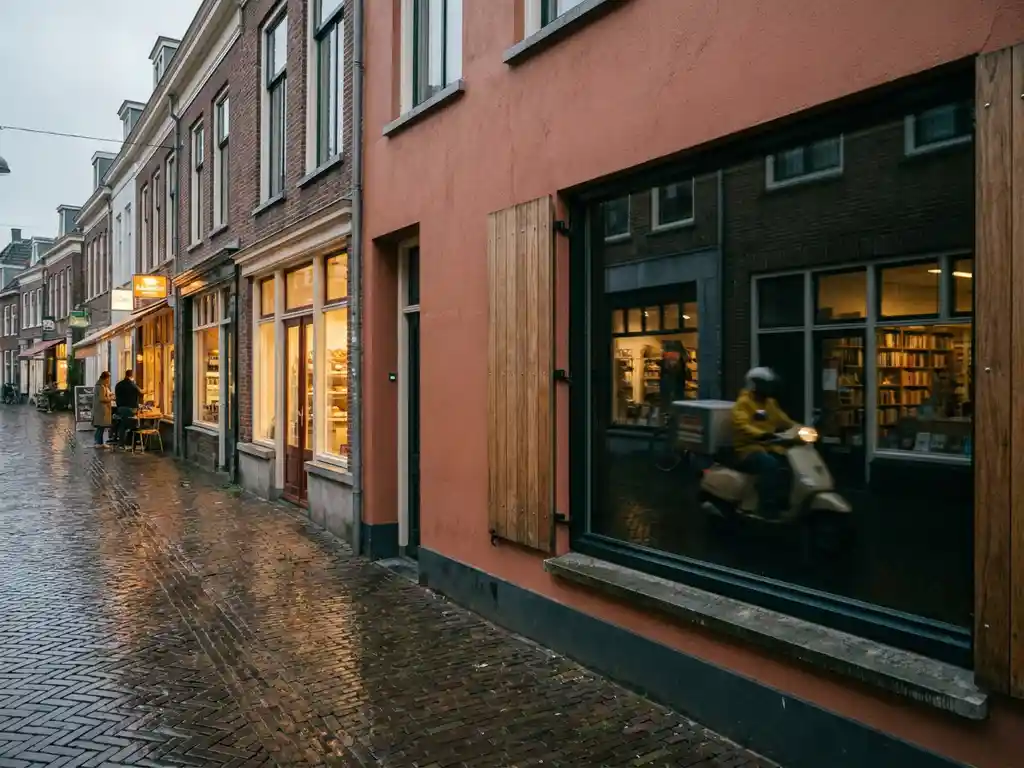
E-commerce has reshaped Dutch high streets, but it has not destroyed them. The clearest impact has been a structural sorting: prime locations in major cities have held their ground or strengthened, while secondary and tertiary streets have experienced persistent vacancy and rental pressure. For international investors evaluating the Dutch retail real estate market, understanding where that line falls is the difference between a resilient asset and a structural underperformer.
The Netherlands has one of the highest e-commerce penetration rates in Europe, which makes it a useful case study in how physical retail adapts rather than disappears. What has emerged is a market defined by polarisation – strong gets stronger, weak gets weaker – and that dynamic runs through every question an investor should be asking about Netherlands high street retail investment.
The sections below address the specific questions that matter most: which locations have held up, which retail formats are still expanding, how vacancy has shifted, and what the lease and yield implications are for investors entering the Dutch market today.
Which Dutch high streets have held up best against e-commerce?
The Dutch high streets that have held up best against e-commerce are concentrated in the A1 locations of the five largest cities: Amsterdam, Rotterdam, Utrecht, Den Haag, and Eindhoven. These streets benefit from dense footfall, strong tourism, and a tenant mix that combines international flagships with experiential retail. The gap between these locations and secondary streets has widened significantly over the past decade.
In Amsterdam, the Kalverstraat and PC Hooftstraat represent two distinct but equally resilient formats. The Kalverstraat draws high footfall from a broad consumer base; the PC Hooftstraat anchors luxury and premium retail with some of the lowest vacancy rates in the country. Both have demonstrated that physical retail in the right location retains genuine commercial value even as online sales grow.
Outside Amsterdam, streets like the Lijnbaan in Rotterdam and the Lange Elisabethstraat in Utrecht have maintained strong occupancy by attracting retailers that need a physical presence for brand building and customer experience. Eindhoven’s 18 Septemberplein area has benefited from its position as a regional shopping destination serving a wide catchment.
What distinguishes these locations is not just footfall volume but footfall quality. Consumers visiting A1 streets in major Dutch cities tend to have clear purchase intent, which translates into conversion rates that justify the rental cost for tenants. That is the commercial logic that keeps prime retail locations in the Netherlands competitive with online channels, rather than simply losing to them.
The contrast with B and C locations is stark. Streets one or two blocks from the prime pitch have seen vacancy rates climb as mid-market retailers rationalise their store networks and direct online sales reduce the need for secondary locations. For investors, the lesson from the past ten years is that location quality in Dutch retail is not a soft criterion – it is the primary determinant of long-term asset performance. KroesePaternotte’s retail market research tracks these location dynamics across the full Dutch market, providing the granular data that distinguishes genuinely prime assets from those that merely appear prime on paper.
What types of retailers are still expanding on Dutch high streets?
The retail categories actively expanding on Dutch high streets in 2026 are food and beverage, health and beauty, sports and outdoor, and value fashion. These formats share a common characteristic: they offer a product or experience that is difficult to replicate online, or they use physical stores as a brand-building tool that supports their digital sales rather than competing with them.
Food and beverage operators – from specialty coffee to fast casual dining – have been among the most consistent expanders on Dutch high streets over the past several years. These tenants generate footfall in their own right and benefit from the concentration of consumers that prime retail streets provide. For landlords, they have become an important part of the tenant mix, though their lease structures and rental levels differ from traditional fashion retail.
Health and beauty is another growth category. Retailers in this segment have found that in-store experience, product testing, and personalised service drive customer loyalty in ways that online channels struggle to match. This has supported continued expansion by both international players and Dutch-origin concepts.
Sports and outdoor retail has also remained active. The category benefits from a consumer trend toward active lifestyles and a product range where fit, feel, and expert advice matter – factors that support the physical store format. Several international sports retailers have used Dutch high streets as European expansion platforms, reflecting confidence in the market’s consumer base.
Value fashion and off-price concepts have expanded into spaces vacated by mid-market retailers, often taking larger footprints at adjusted rental levels. These tenants are not always ideal from a yield perspective, but they perform an important function in maintaining footfall on streets that might otherwise see vacancy cluster.
Understanding which retail tenants in the Netherlands are expanding – and which are contracting – requires current leasing market intelligence. Investors who rely on historical occupancy data without understanding the active tenant pipeline risk misjudging re-letting potential when a lease expires.
How has e-commerce changed vacancy rates in Dutch city centres?
E-commerce has contributed to a structural increase in vacancy rates on secondary and tertiary Dutch shopping streets, while prime city centre locations have largely maintained low vacancy. The overall picture across Dutch city centres is one of polarisation: the strongest streets remain highly sought after, while weaker streets carry vacancy levels that reflect a permanent reduction in demand from certain retail categories.
The vacancy increase is not evenly distributed. In smaller cities and towns, the impact has been more severe, with some secondary shopping streets losing anchor tenants and struggling to attract replacement occupiers. In the four or five largest Dutch cities, vacancy on prime streets has remained low because demand from expanding retail categories and international brands has absorbed the space left by contracting mid-market fashion retailers.
The structural nature of this change matters for investment analysis. Some of the vacancy visible in Dutch city centres today is not cyclical – it will not resolve when consumer confidence improves. It reflects a permanent shift in how certain retail categories allocate their physical store networks. Investors assessing Dutch shopping street vacancy rates need to distinguish between vacancy that can be re-let at or near current passing rent and vacancy that signals a location has structurally weakened.
Dutch municipal authorities have responded with zoning changes and urban planning interventions intended to rebalance city centres – converting retail space to residential, hospitality, or mixed use in locations where retail demand has durably declined. These interventions can affect the investment case for assets in transitional areas, adding a layer of planning risk that is specific to the Dutch market context.
How do Dutch lease structures affect high street retail performance?
Dutch retail lease structures directly affect high street performance because they determine how rental income adjusts over time and how disputes about market rent are resolved. The key mechanism is the Article 303 rent review process, which allows either landlord or tenant to request a market rent review every five years. This process anchors rents to demonstrable market evidence rather than allowing them to drift significantly above or below market levels.
For investors, the Article 303 framework has two important implications. First, it provides a degree of income stability – rents are indexed annually (typically to the consumer price index) and can be reviewed to market levels at five-year intervals. Second, it creates risk in locations where market rents have declined. An asset where passing rent exceeds current market rent – known in the Dutch market as overhuurde – carries the risk of a rent reduction at the next review, which directly affects income and capital value.
The lease term structure in Dutch retail is typically five years with renewal options, though longer terms are negotiated for anchor tenants and flagship locations. Shorter lease terms increase the frequency of re-letting events, which matters for vacancy risk assessment in a market where tenant demand is polarised by location quality.
Indexation clauses are standard in Dutch retail leases and provide a degree of inflation protection for landlords. However, the interaction between indexation and Article 303 reviews means that income projections require careful modelling, particularly for assets in markets where rents have moved materially since the last review date.
Assessing whether a specific asset’s lease structure represents risk or opportunity requires detailed knowledge of current market rents at the street and unit level. KroesePaternotte’s valuations and rent review practice covers this analysis for investors and landlords across the full Dutch retail market, drawing on lease transaction data going back to 1984 – a depth of market evidence that no generalist firm can match.
What does online shopping growth mean for Dutch retail investment yields?
Online shopping growth has contributed to yield differentiation across the Dutch retail property market: prime high street assets in strong locations have seen yield compression as investor demand concentrates on quality, while secondary and tertiary assets carry wider yields that reflect higher vacancy risk and uncertain re-letting prospects. The net effect is a market where location quality is priced more precisely than at any point in the past two decades.
For investors focused on Netherlands retail property yields, the relevant question is not what the average retail yield is, but what yield is appropriate for a specific asset given its location quality, tenant covenant, lease structure, and re-letting risk. Prime high street retail in Amsterdam’s best streets trades at yields that reflect strong investor demand and limited supply. Assets in secondary locations carry a material yield premium that is not simply a buying opportunity – it reflects genuine risk.
The investment volumes in the Dutch retail market have recovered meaningfully, with 2025 seeing a significant increase in transaction activity. That recovery has been concentrated in assets that institutional investors regard as structurally sound: long-leased assets with strong tenants, prime location credentials, and lease structures that do not carry overhuurde risk. Assets that do not meet those criteria have been slower to transact, which is itself a signal about where market confidence sits.
For international investors evaluating retail real estate in the Netherlands, the yield question cannot be separated from the location and lease questions. A net initial yield that looks attractive on a secondary asset may reflect risk that is difficult to quantify without current leasing market intelligence. Conversely, a compressed yield on a prime asset may be well-supported by rental growth potential and low vacancy risk that justifies the pricing.
Getting that assessment right requires a combination of investment market knowledge and operational retail market insight that most generalist advisors cannot provide. KroesePaternotte’s retail investment advisory covers the full transaction cycle – from acquisition search and yield substantiation to asset optimisation and disposal – with the benefit of simultaneous activity across leasing, valuation, and research. For international capital seeking to invest in Dutch retail real estate, that integrated perspective is the local edge that makes the difference between a well-priced acquisition and an expensive mistake.
If you are evaluating specific assets or locations in the Dutch retail market, the KroesePaternotte team is available to provide current market intelligence and transaction support across all major Dutch cities and retail formats.
Related Articles
- What is the relationship between consumer spending and retail rents in the Netherlands?
- How far in advance do you need to give notice to terminate a retail lease?
- How has the Dutch retail market recovered after COVID?
- How to rent a pop-up retail space in a busy city centre?
- How do you combine a physical shop with an online shop at the same location?
- What is an A1 location in the Netherlands?
- What is a net initial yield in Dutch retail property?
- How do Dutch retail property yields compare to other asset classes?
- How do location grades affect retail property pricing in the Netherlands?