
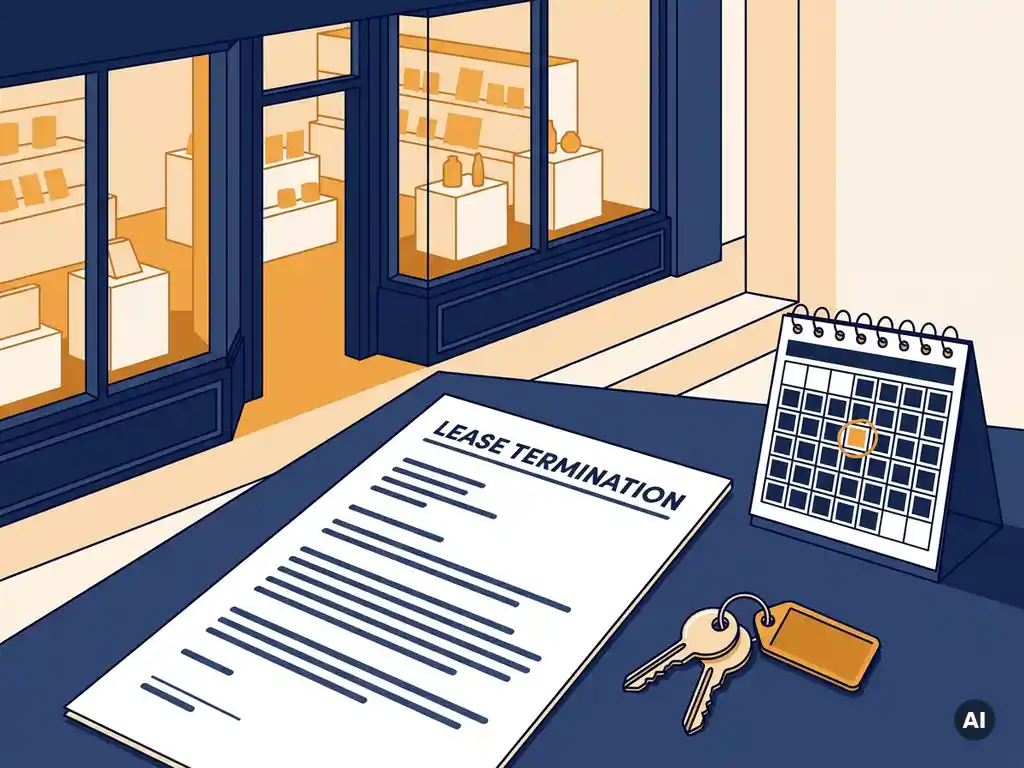
For most retail lease agreements in the Netherlands, a notice period of twelve months applies. This means you must give written notice one year before the end of the lease period, otherwise the contract automatically continues. The exact notice period is always stated in your lease agreement, but twelve months is the standard in the Dutch retail market. In this article, we answer the most frequently asked questions about terminating a retail lease.
What happens if you give notice too late?
If you give notice on a retail lease too late, the contract automatically continues for a new period. For most retail leases, this means an extension of five years, unless a shorter renewal period has been agreed upon in the contract. You are then legally obligated to continue paying rent for the full new period.
The consequences can therefore be significant. Suppose your lease expires on 1 January 2027 and your notice period is twelve months. In that case, you would have had to give written notice no later than 1 January 2026. If you fail to do so, you are automatically bound to a new five-year contract. If you still want to leave earlier, you are dependent on the landlord’s willingness to cooperate with an early termination, or on a possible break option in your contract.
It is therefore wise to keep a close track of the end date and notice period of your lease. Set a reminder in your calendar well before the notice period begins, so you are not caught off guard.
Does a fixed notice period apply to every retail lease?
No, there is no legally established notice period for retail leases in the Netherlands. The notice period is determined contractually and can vary per agreement. In practice, twelve months is the most commonly used period in the Dutch retail market, but six months also occurs, particularly with shorter or more flexible lease forms.
Dutch law (Article 7:293 of the Civil Code) does stipulate that termination of a commercial lease must be done in writing, but does not prescribe a minimum period. Parties are free to agree on their own notice period in the contract. Standard retail premises often make use of the ROZ model, a standard contract drawn up by the Council for Real Estate Affairs. In this model, twelve months is the standard notice period.
Always review your own contract carefully. The notice period is typically stated in the provisions regarding lease termination or contract renewal. If you are unsure about what is in your contract, it is advisable to have it reviewed by a specialist in retail real estate. Guidance on lease contract terms is part of the services offered by KroesePaternotte, which works with retail lease agreements across the Netherlands on a daily basis.
How do you correctly terminate a retail lease?
You terminate a retail lease by sending a written notice of termination to the landlord, within the contractually agreed notice period. The letter must be sent by registered post or bailiff’s writ, so that you have legal proof of the date of receipt. An email or verbal notification is in most cases not legally valid.
A correct notice of termination contains at least the following elements:
- The full name and address details of the tenant
- The name and address details of the landlord
- The address of the leased retail premises
- The end date of the lease contract on which you are giving notice
- A clear statement that you are terminating the lease agreement
- Date and signature
Send the letter preferably by registered post with acknowledgement of receipt. Keep proof of dispatch and receipt carefully. If the landlord disputes receipt or the letter never arrives, this proof is essential to demonstrate that you gave notice in time.
Also check whether your contract places additional requirements on the notice, such as a specific form or a required notification to a shopping centre manager. In more complex lease structures, such as in shopping centres, different procedures sometimes apply.
What is a break option and how does it work?
A break option is a contractual provision that gives the tenant (or landlord) the right to terminate the lease early on a predetermined date, without this being considered a breach of contract. It is an exit point built into the contract, often halfway through a long-term lease period.
Suppose you have a lease for five years, starting on 1 January 2024. A break option in year three would mean that you can give notice as of 1 January 2027, provided you announce this in time. The notice period for a break option is typically six to twelve months and is explicitly stated in the contract.
Break options are not standard in every lease contract. They are negotiated when the contract is concluded and are particularly valuable for retailers who want to grow, downsize, or relocate without being tied to a location for years. For start-up entrepreneurs and growing brands who are not yet sure how their needs will develop, a well-negotiated break option can make the difference between flexibility and a long-term obligation.
It is important to read the conditions of a break option carefully. Sometimes additional requirements are attached to its use, such as having fully met all rent payments or restoring any alterations made to the premises.
Can a landlord force you to stay after the notice period?
No, a landlord cannot force you to continue renting after you have validly and timely terminated the contract. If you have correctly followed the notice period and the termination is legally valid, the lease ends on the agreed date. The landlord has no legal basis to compel the tenant to remain.
However, the tenant is obliged to return the retail premises in their original condition, unless otherwise agreed. This means that modifications made, such as flooring, shelving, or lighting, may need to be removed. What does and does not need to be removed is stated in the lease contract or the associated handover protocols.
What landlords can do is object if the notice was not given correctly or not given in time. In that case, the landlord can claim that the contract has been extended and demand compliance. That is why it is so important to give notice demonstrably and within the deadline.
Do you have questions about your specific situation, or are you looking for retail premises where the lease conditions are properly arranged from the outset? Contact KroesePaternotte. As a specialised retail property agent, we assess lease contract terms on the basis of current market data and a database going back to 1984, so you know what is in line with the market and what is not. Also view the current retail property listings for locations throughout the Netherlands.
Related Articles
- How do you conduct due diligence on a Dutch retail property?
- How do you find a small retail space in the city center that isn't listed on Funda?
- Should you buy or rent a retail property as a retailer?
- How does a bank guarantee work when renting commercial space?
- What due diligence is needed for Dutch retail property investment?
- How do supermarket anchors affect retail property values?
- How does a rent review affect your retail investment return?
- How does the Dutch retail property transaction process work?