
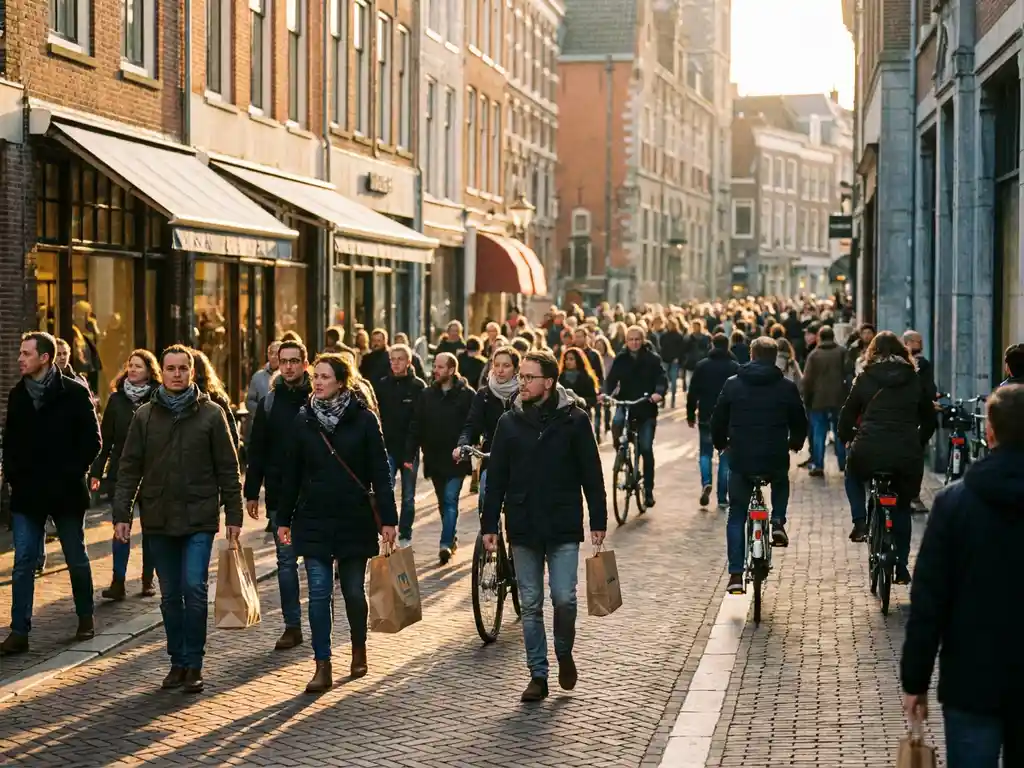
The Dutch retail real estate market has largely recovered from the COVID-19 pandemic, with footfall returning to pre-pandemic levels in most prime locations and investment volumes rising sharply in 2025. The recovery has not been uniform, however. Strong locations have strengthened further, while weaker retail areas have continued to decline. For international investors evaluating Dutch retail property, understanding which formats and locations drove the recovery is essential to making sound acquisition decisions.
Which Dutch retail formats recovered fastest after COVID?
Supermarkets and food-anchored retail recovered fastest after COVID in the Netherlands, followed closely by prime high street retail in the country’s strongest shopping cities. These formats benefited from essential-goods demand during lockdowns and rebounded quickly once restrictions lifted. Discretionary retail in secondary and tertiary locations took considerably longer to stabilise.
Standalone supermarkets proved the most resilient asset class throughout the pandemic period. Their essential-use status, long lease terms, and strong covenant quality meant that income streams remained largely uninterrupted. This drove significant investor interest in supermarket-anchored assets and food-led retail parks, a trend that has continued into 2026.
Prime high street retail in cities like Amsterdam, Rotterdam, Utrecht, and Den Haag also recovered relatively quickly. Footfall returned to major pedestrian shopping streets as soon as restrictions were lifted, supported by the Netherlands’ high urban density and strong domestic consumer base. In contrast, mid-range shopping centres and retail in smaller cities faced a slower and more uneven recovery, with some locations still working through structural vacancy challenges.
PDV and GDV concentrations (large-format retail parks focused on furniture, electronics, and home improvement) also performed solidly during the recovery phase, benefiting from the home improvement surge that characterised the pandemic period across Europe.
How has consumer behaviour in the Netherlands changed since the pandemic?
Dutch consumer behaviour has shifted meaningfully since the pandemic, with a stronger preference for experience-led retail, convenience, and omnichannel shopping. E-commerce adoption accelerated during lockdowns and has remained elevated, but physical retail has proven more resilient than many predicted, particularly in strong urban locations where the shopping experience itself is the draw.
The Dutch consumer now expects a seamless blend of online and offline retail. Retailers that have invested in click-and-collect, in-store experience, and digital integration have generally maintained or grown their physical footprints. This has made tenant quality increasingly important for landlords and investors: retailers with strong omnichannel models are better positioned to sustain lease commitments over the medium term.
Leisure and food and beverage have taken a growing share of retail floor space in the Netherlands, as landlords and developers have repositioned centres to meet demand for experiences rather than pure product. This trend is visible in major shopping centres across the country, where traditional fashion tenants have been replaced by fitness operators, restaurants, and entertainment concepts.
E-commerce penetration in the Netherlands is among the highest in Europe, which has placed structural pressure on certain retail categories, particularly electronics, books, and standardised fashion. However, categories such as beauty, sportswear, and premium fashion have shown that physical retail remains central to the consumer journey, even when the purchase ultimately happens online.
What happened to retail vacancy rates in the Netherlands after COVID?
Dutch retail vacancy rates rose during the pandemic but have since improved in prime locations, even as structural vacancy persists in secondary and weaker markets. The overall national vacancy picture masks a significant divergence: A1 locations in major cities have seen vacancy tighten, while B and C locations in smaller towns continue to face elevated, and in some cases rising, vacancy.
The Netherlands entered the pandemic with an already bifurcated retail market. Years of e-commerce growth and retail restructuring had already pushed vacancy higher in non-prime areas. COVID accelerated this divergence rather than creating it. The result is that the post-pandemic vacancy story in the Netherlands is really two separate stories depending on location quality.
In Amsterdam’s prime shopping streets, vacancy has remained low and competition for available units is strong. The same is true for prime pitches in cities such as Utrecht, Eindhoven, and Groningen. In contrast, smaller regional towns and peripheral retail areas have seen vacancy remain stubbornly high, with some units struggling to attract any viable tenant at market rents.
For investors assessing Dutch retail investment opportunities, vacancy risk is therefore highly location-specific. National vacancy data provides limited guidance; what matters is the vacancy trend at the specific pitch, street, and catchment level. This is precisely the kind of granular intelligence that distinguishes informed acquisition decisions from ones based on macro data alone.
How have Dutch retail rents and yields moved since 2020?
Dutch retail rents in prime locations have recovered and in some cases grown since 2020, while yields moved out during the period of interest rate rises before beginning to stabilise and compress in stronger locations by 2025 and into 2026. The rental and yield picture is highly format and location dependent, with prime high street and supermarket assets performing very differently from secondary retail.
Rental trends since 2020
Prime high street rents in the Netherlands fell during the pandemic as retailers renegotiated leases and some vacated. Since then, rents in the strongest locations have recovered, supported by limited supply of prime units and continued demand from international and domestic retailers seeking flagship positions. In secondary locations, rents have remained under pressure, and in some cases landlords have accepted lower headline rents to secure or retain tenants.
The Dutch lease structure includes indexation provisions that have supported income growth in recent years, as CPI-linked rent reviews have driven nominal rent increases across the market. However, investors should be aware that the huurprijsherziening process under Article 303 of Dutch lease law allows tenants to challenge market rents if passing rents are above the market level, which creates specific risk for assets where headline rents were set in a stronger market environment.
Yield movements since 2020
Dutch retail yields moved out significantly between 2022 and 2024 as rising interest rates repriced real estate across Europe. Prime retail net initial yields in the Netherlands, which had compressed to historically low levels pre-pandemic, widened considerably during this period. By 2025 and into 2026, yields in the strongest retail formats have begun to stabilise, and there is evidence of yield compression in prime high street and supermarket-anchored assets as investor demand returns.
For international investors, the current yield environment offers entry points that were not available during the low-rate period. Net initial yields on prime Dutch high street retail and food-anchored assets now reflect a more realistic risk-adjusted return profile, making this a structurally interesting moment to assess the market.
Are Dutch shopping centres outperforming or underperforming high streets?
In the Netherlands, prime high streets are generally outperforming secondary shopping centres on both footfall and rental performance since the pandemic. However, dominant, well-anchored shopping centres in strong catchment areas continue to perform solidly, while weaker centres without clear differentiation face structural challenges that predate COVID and have worsened since.
The Dutch shopping centre market is highly polarised. The country’s best-performing centres benefit from strong anchor tenants, high catchment populations, and active asset management. These assets have attracted continued occupier demand and maintained rental income. Weaker centres, particularly those in markets with competing retail supply or declining catchments, have struggled to replace departing tenants at sustainable rents.
Prime high streets in cities such as Amsterdam, Utrecht, and Eindhoven have proven particularly resilient because they offer something shopping centres cannot replicate: an authentic urban environment that attracts both domestic shoppers and international visitors. The PC Hooftstraat in Amsterdam, for example, continues to command strong demand from luxury and premium brands, with very limited availability and significant competition for any unit that does come to market.
For investors, the key distinction is not simply high street versus shopping centre but dominant versus non-dominant within each format. A dominant regional shopping centre with a strong food anchor and high footfall can outperform a secondary high street. The format label matters less than the asset’s position within its local retail hierarchy, which is why granular market research at the location level is essential before any acquisition decision.
What does the Dutch retail market outlook look like for investors?
The Dutch retail real estate market outlook for 2026 is cautiously positive, particularly for prime high street assets, supermarket-anchored properties, and dominant shopping centres. Investment volumes rose 61% in 2025, signalling renewed institutional and international confidence. However, the market remains bifurcated, and location selection is the single most important variable in determining investment performance.
Several structural factors support the Dutch retail market over the medium term. The Netherlands has a stable, high-income consumer base, a transparent legal and regulatory framework, and a liquid real estate market with a well-developed institutional investment sector. The country’s urban density supports footfall in prime retail locations, and the continued expansion of international retailers into the Dutch market sustains demand for quality retail space.
The risks are real and should not be underestimated. E-commerce penetration remains high, structural vacancy in non-prime locations is unlikely to reverse, and the huurprijsherziening mechanism creates income risk for assets with above-market passing rents. Investors unfamiliar with Dutch lease law and local market dynamics face meaningful risk of overpaying for assets in locations that appear attractive on paper but face underlying structural challenges.
The strongest opportunities in 2026 are concentrated in a limited number of locations and formats: prime high street units in the Netherlands’ top five to eight cities, supermarket-anchored assets with long leases and strong covenant quality, and dominant shopping centres with proven footfall and active management. These assets are scarce, competitively sought, and require local intelligence to access and price correctly.
KroesePaternotte has been advising on Dutch retail real estate since 1984, with a transaction and data record that spans virtually the entire modern history of the market. For international investors seeking a local partner who can assess whether an asset is correctly priced, evaluate re-letting potential, and substantiate yield assumptions with current market evidence, the firm’s retail investment advisory provides exactly that capability. The Dutch retail market rewards those who understand it at the location level. That understanding is what separates a well-priced acquisition from an expensive mistake.
Related Articles
- What are prime retail locations in the Netherlands?
- What is the difference between renting through an estate agent or searching yourself?
- What is the difference between prime and secondary retail locations?
- What is a 303 valuation in the Netherlands?
- What is indexation in a Dutch retail lease?
- What causes retail vacancy on Dutch shopping streets?
- What is the RICS standard and why does it matter for retail valuations?
- How do you assess the future rent potential of a Dutch retail property?
- How does Dutch lease law affect retail real estate investors?