
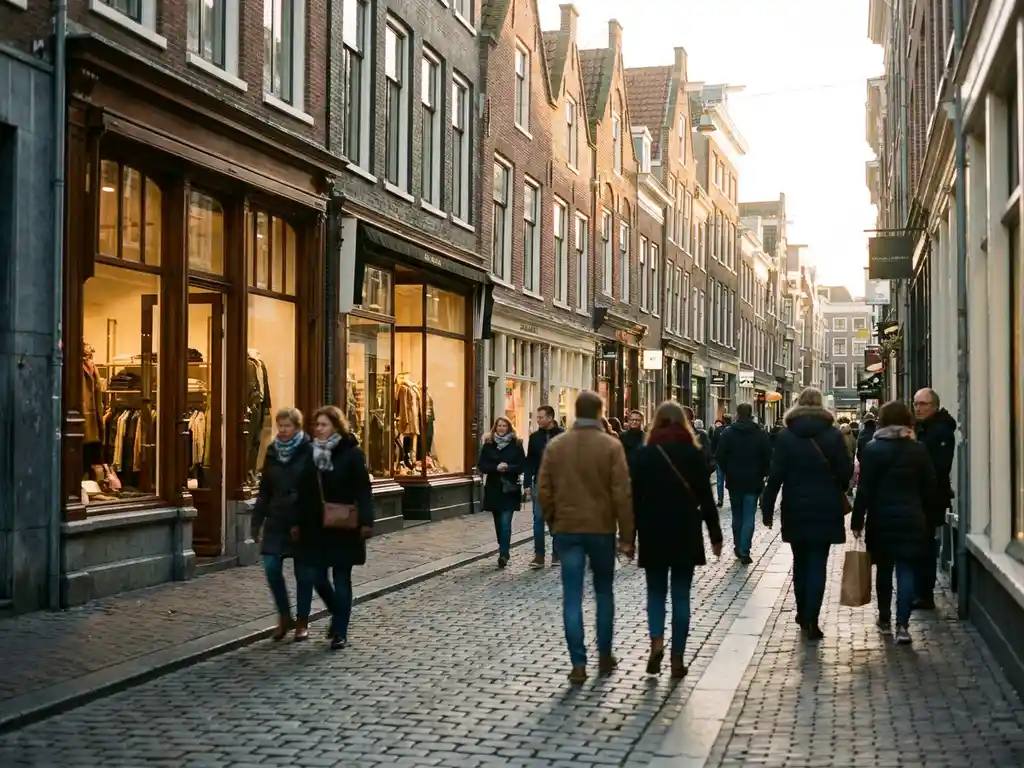
Amsterdam, Utrecht, Rotterdam, and The Hague consistently show the strongest retail demand in the Netherlands, driven by high footfall, dense consumer populations, and a concentration of prime high street locations. The gap between these cities and secondary markets is significant, but several mid-sized Dutch cities are closing that gap with genuine rental growth momentum. This article answers the most important questions international investors ask about Dutch retail demand, location quality, vacancy, and yield potential.
Which city formats drive the strongest retail footfall in the Netherlands?
The formats generating the strongest retail footfall in the Netherlands are prime high streets in major cities, dominant regional shopping centres, and standalone supermarkets. High streets in Amsterdam, Utrecht, Rotterdam, and The Hague attract the highest pedestrian volumes, while large-format shopping centres in suburban and regional locations serve as primary retail destinations for surrounding catchment areas.
Within these formats, performance varies sharply by specific location. A prime high street in Amsterdam draws an entirely different footfall profile than a secondary shopping street in the same city. Dominant regional centres such as those anchored by full-line supermarkets or major fashion retailers consistently outperform smaller, non-dominant centres that face structural competition from stronger nearby alternatives.
PDV and GDV concentrations, which group large-format retail such as furniture, electronics, and DIY, generate high-volume traffic from destination shoppers rather than casual browsers. These formats have proven resilient because the product categories they serve are difficult to replicate online. For investors evaluating format risk, the distinction between dominant and non-dominant assets within each format matters more than format type alone.
Why does Amsterdam consistently outperform other Dutch retail markets?
Amsterdam outperforms other Dutch retail markets because it combines the country’s highest tourist volumes, the densest urban consumer population, and a concentration of internationally recognised prime streets that attract both global luxury brands and mass-market retailers. Kalverstraat and PC Hooftstraat remain among the most sought-after retail addresses in Northern Europe, with demand consistently exceeding available supply.
The structural drivers are durable. Amsterdam’s international connectivity, growing resident population, and position as a European headquarters city sustain retail spending across economic cycles. International retailers entering the Dutch market almost always prioritise Amsterdam as their first location, which reinforces tenant quality and keeps vacancy on prime streets extremely low.
For investors, this translates into yield compression on prime Amsterdam assets relative to other Dutch cities. The trade-off is lower initial yields against stronger rental security, lower vacancy risk, and greater liquidity when it comes to exit. Assets on the best Amsterdam high streets rarely come to market, and when they do, competition among buyers is intense. Understanding which specific streets and blocks within Amsterdam qualify as genuine A1 locations requires the kind of granular, transaction-level intelligence that KroesePaternotte’s retail research is built on.
Which secondary Dutch cities show the strongest retail rental growth?
Utrecht, Eindhoven, and Groningen show the strongest retail rental growth among secondary Dutch cities in 2026. Utrecht benefits from its central location, large student and professional population, and a high street that rivals Amsterdam in terms of tenant quality. Eindhoven has seen sustained demand from both domestic and international retailers drawn to its affluent catchment and strong retail infrastructure. Groningen serves as the dominant retail centre for the northern Netherlands, with limited competition from nearby alternatives.
What these cities share is market dominance within their regional catchment. They are not just large cities; they are the clear primary retail destination for a wide surrounding area. This dominance supports rental growth because retailers have no credible alternative if they want meaningful reach into those consumer markets.
Cities like Breda, Nijmegen, and Tilburg also show positive leasing momentum, particularly on their primary shopping streets, though rental growth there is more selective and location-dependent. The pattern across all secondary markets is consistent: rental growth concentrates on the top streets and dominant centres, while secondary streets within the same city can face stagnation or decline. Active leasing advisory in these markets provides the current deal-level data needed to distinguish between the two.
What is the difference between an A1 and a B-location in Dutch retail?
An A1 location in Dutch retail is the section of a shopping street with the highest pedestrian counts, strongest tenant mix, and lowest vacancy. A B-location is typically adjacent to or branching off the A1 zone, with noticeably lower footfall, weaker tenant demand, and higher vacancy sensitivity. In the Netherlands, the performance gap between an A1 and a B-location can be extreme, with rents and occupancy rates diverging sharply even within the same street.
Dutch retail geography is highly granular. A single street can transition from A1 to B-quality within 100 metres, and experienced local specialists can identify exactly where that transition occurs. For an international investor unfamiliar with the local market, this is one of the most significant risks in Dutch retail real estate: paying A1 prices for an asset that the market treats as B-quality.
The practical implications for investment are substantial. A1 locations command lower vacancy risk, stronger tenant covenants, and more predictable rental income. B-locations may offer higher initial yields but carry meaningful re-letting risk, particularly if an anchor tenant vacates. Before acquiring any Dutch retail asset, verifying its precise location classification using transaction-level data, not just the street name, is essential. KroesePaternotte’s valuation and rent review practice uses lease data going back to 1984 to substantiate exactly where an asset sits within the location hierarchy.
How do Dutch retail vacancy rates vary by city and format?
Dutch retail vacancy rates vary significantly by city, location within the city, and retail format. Prime high streets in Amsterdam, Utrecht, and Eindhoven maintain very low vacancy, often in the low single digits on A1 sections. Secondary streets in mid-sized cities and smaller regional centres carry materially higher vacancy, and some non-dominant shopping centres face structural vacancy challenges that are unlikely to resolve without significant repositioning.
Vacancy by city tier
Major cities with strong fundamentals, particularly Amsterdam, Utrecht, and Rotterdam, show stable to declining vacancy on their prime streets. The picture is more mixed on secondary streets within these same cities, where some units have remained empty for extended periods as retailers concentrate their footprints on the highest-performing locations. In smaller cities and towns, vacancy can be severe on all but the very best streets, reflecting long-term structural decline in retail spending in those catchments.
Vacancy by format
Standalone supermarkets show the lowest vacancy of any Dutch retail format, given the essential nature of the product and the long leases that supermarket operators typically sign. Prime high street retail in major cities sits at the next level of vacancy security. Non-dominant shopping centres and secondary high streets carry the highest vacancy risk, and this risk has not meaningfully reversed since the structural shifts accelerated by e-commerce growth and changing consumer habits. Understanding vacancy at the asset level, not just the market level, is what separates a sound investment from an expensive mistake.
Which Dutch retail markets offer the best risk-adjusted returns for international investors?
For international investors seeking the best risk-adjusted returns in Dutch retail real estate, prime high street assets in Amsterdam and Utrecht, dominant regional shopping centres, and standalone supermarkets in strong catchments offer the most defensible combination of income security and capital value stability. These assets carry lower initial yields than secondary alternatives but significantly lower re-letting risk, stronger tenant covenants, and greater exit liquidity.
The Netherlands benefits from a transparent legal framework, stable macroeconomic conditions, and a lease structure that includes indexation, providing a degree of inflation protection on rental income. However, Dutch-specific dynamics such as the Article 303 market rent review process, the methodology for huurprijsherziening, and the distinction between contractual rent and market rent can materially affect income projections for investors unfamiliar with local practice. Overhuurde properties, where the contracted rent exceeds current market rent, represent a specific risk that requires careful due diligence.
Investment volumes in Dutch retail rose sharply in 2025, and the 2026 market outlook reflects continued institutional interest in well-located, income-producing retail assets. The supply of genuinely prime assets remains constrained, which supports pricing on the best locations while creating meaningful differentiation from weaker stock. For international capital entering this market, the single most important factor is working with a local specialist who has current transaction intelligence across leasing, valuation, and investment simultaneously.
KroesePaternotte’s retail investment advisory covers the full transaction cycle from acquisition search and due diligence through to disposal, with national coverage across all major Dutch cities and retail formats. With active involvement in leasing, valuations, and investment transactions, the firm provides the integrated market intelligence that international investors need to assess whether an asset is correctly priced and what its realistic yield trajectory looks like. To understand how that translates into a specific investment mandate, learn more about KroesePaternotte or explore the full range of services.
Related Articles
- What are the best high streets to invest in the Netherlands?
- What are footfall trends on Dutch shopping streets?
- What drives rental growth in Dutch retail real estate?
- What investment opportunities exist on the PC Hooftstraat?
- What is the Dutch retail real estate market?
- What are the risks of investing in Dutch retail property?
- When is renting in a busy shopping street the right choice?
- How do you find a small retail space in the city center that isn't listed on Funda?