
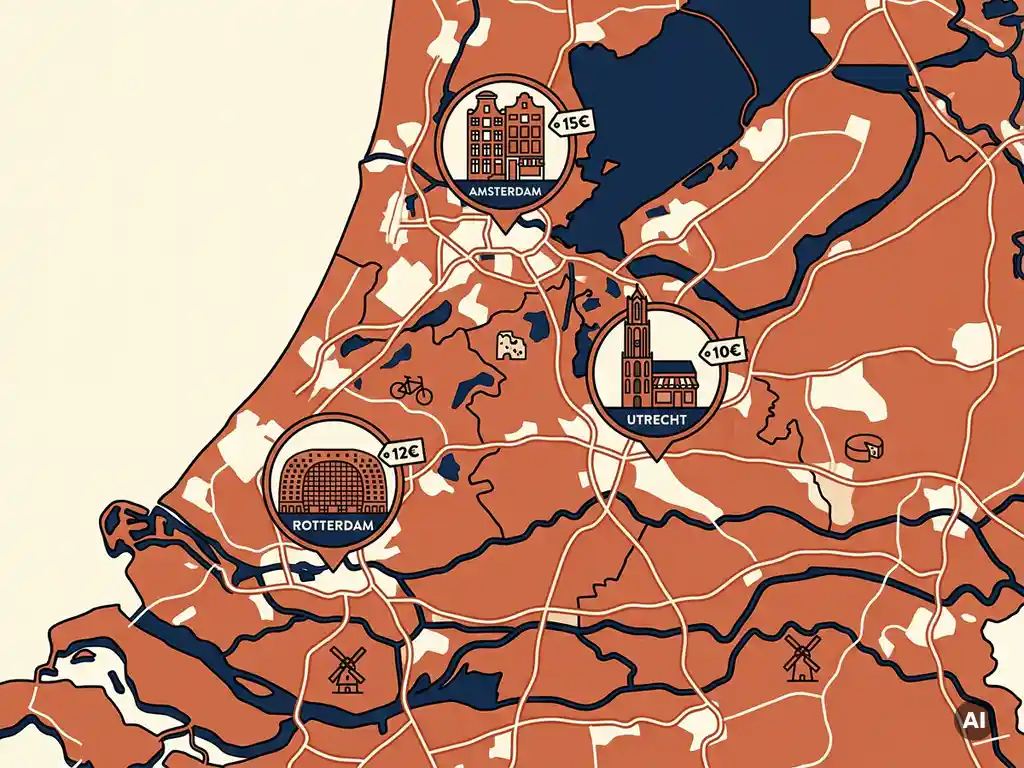
Comparing rental prices per m² between different cities requires placing location type, footfall, catchment area, and market dynamics side by side for each city. A retail space on Amsterdam’s Kalverstraat has a fundamentally different rental value than a comparable space in the city centre of Enschede. Understanding which factors determine the price allows you to quickly assess whether an offer is realistic. The sections below answer the most frequently asked questions about retail space rental prices in the Netherlands.
Which factors determine the rental price per m² of a retail space?
The rental price per m² of a retail space is determined by location, footfall, retail floor area, sector, and the local supply-demand ratio. Location is by far the most significant factor: the same 100 m² can cost two to three times as much on a busy shopping street as on a side street fifty metres away.
In addition to location, the following factors play a role:
- Footfall: the more pedestrian traffic, the higher the rental value
- Shop width and shopfront: a wide façade attracts more customers and is therefore worth more
- Floor distribution: the ground floor is always more expensive than basement space or upper floors
- Sector and permitted use: food retail and personal care typically pay higher rents than furniture stores
- Lease term: longer contracts sometimes come with a lower initial rent
- Market conditions: in tight markets, retail rental prices in the Netherlands rise; they fall when vacancy increases
The interplay of these factors makes it difficult to judge based on a single metric. A rental price for retail space per m² that appears high at first glance may be entirely in line with the market if the location is exceptionally strong.
What are typical rental prices per m² in the major Dutch cities?
Typical rental prices per m² for retail space in 2026 range from roughly €150 per m² per year in medium-sized cities to more than €2,000 per m² per year at the very best A1 locations in Amsterdam. The exact level depends strongly on the city, the street, and the location type.
As an indicative range for A1 locations in the largest cities:
- Amsterdam (Kalverstraat, P.C. Hooftstraat): highest rental prices in the Netherlands, well above the national average
- Rotterdam and The Hague: strong rental prices on the best shopping streets, but clearly lower than Amsterdam
- Utrecht: high occupancy rates in the city centre translate into above-average rental prices
- Eindhoven, Groningen, Arnhem: healthy A1 rents, with more room for negotiation than in the Randstad
- Medium-sized cities: rental prices vary considerably; the position within the city is decisive
Exact figures per street are available through specialist parties. KroesePaternotte holds lease transaction data going back to 1984 and covers virtually the entire Dutch retail market. That historical depth makes it possible not only to assess the current level, but also to evaluate the trend per location.
How does an A1 location differ from an A2 or B location in terms of rental price?
An A1 location is the busiest shopping street or core area of a city with the highest footfall. An A2 location is adjacent to that core area, with slightly less through traffic. A B location falls outside the primary retail area. The rental price difference between A1 and B can amount to a factor of three or more for comparable floor areas.
In practice, this means:
- A1: maximum visibility, highest rental price, limited availability, strong demand from national and international chains
- A2: good accessibility and visibility, rental price clearly lower than A1, attractive for concepts that cannot sustain the very highest rent
- B location: lower rental costs, but also less spontaneous footfall; suitable for destination stores or service providers with a fixed customer base
For a starting retailer, the temptation to choose a B location because of lower costs is great. But a low rental price at a weak location is no advantage if turnover disappoints due to a lack of footfall. The rental price for retail space per m² must always be weighed against the expected revenue potential of that location.
What is the difference between base rent and total occupancy costs per m²?
Base rent is the basic amount per m² you pay for the use of the space itself. Total occupancy costs per m² also include service charges, contributions to shopping centre marketing funds, energy costs, insurance, and any turnover-related rent components. The difference can amount to tens of percentage points.
In practice, total occupancy costs often consist of:
- Base rent: the contractually agreed rental price, indexed annually
- Service charges: contribution to joint management, cleaning, security, and common areas
- Marketing contribution: mandatory in many shopping centres, for joint promotion and events
- Turnover-related rent: in some contracts, you pay an additional percentage above a turnover threshold
- VAT: retail space is generally leased with VAT, which represents an additional cost for tenants not liable for VAT
When comparing rental prices per m² between locations, you must always use total occupancy costs as the basis for comparison. A low base rent with high service charges can end up being more expensive than a higher base rent with low additional costs. Always review the current retail listings including an overview of all costs.
How do you verify whether an asking rental price is in line with the market?
An asking rental price is in line with the market if it corresponds to recent transactions for comparable spaces at comparable locations in the same city. The most reliable way to verify this is by accessing current transaction data for comparable properties, combined with knowledge of local market dynamics.
Practical steps to assess market conformity:
- Compare the location type: is the offered space genuinely an A1 location, or is the landlord presenting an A2 location as A1?
- Ask for reference transactions: what rents have recently been paid for comparable spaces on the same street or in the same shopping centre?
- Look out for incentives: a rent-free period or contribution to fit-out costs can reduce the effective rental price; always compare the net rent after incentives
- Check the indexation clause: a low initial rent with high annual indexation can end up being more expensive after five years than a higher fixed rent
- Consult a specialist: public portals show asking prices, not transaction prices
The problem for many entrepreneurs is that transaction data is not publicly available. Landlords and their agents have access to this information; tenants generally do not. That information advantage is precisely why engaging a specialist retail agent is worthwhile when renting retail space.
When is it smart to engage a retail specialist for rental price comparison?
It is smart to engage a retail specialist as soon as you are seriously considering renting a specific space or making a location decision that will be binding for several years. At that point, the quality of your information outweighs the cost of advice. A mistake in the rental price comparison or an unfavourable contract clause can affect your operations for years to come.
Specific situations in which specialist advice adds direct value:
- You have no reference point for what a market-conform rental price for retail in the Netherlands is for your type of location
- You are comparing multiple cities or locations and want an objective assessment of their relative attractiveness
- The landlord or their agent clearly has more market knowledge than you
- You want to negotiate rent-free periods, break options, or incentives, but do not know what is realistic
- The location you are looking for is rarely or never publicly listed
KroesePaternotte is a specialist retail agent that operates exclusively in retail real estate. The team is in daily contact with owners and developers of the best retail locations in the Netherlands, including properties that never appear on public portals. That combination of market data, network, and negotiation expertise is difficult for a starting or growing retailer to replicate independently. Get in touch for a no-obligation conversation about your location challenge, or read more about the background and approach of the firm.
Related Articles
- What are the risks of a too-long lease term for a retail shop?
- Can you terminate a commercial lease early?
- What is the difference between gross and net rental yield in Dutch retail?
- How do you assess retail tenant quality in the Netherlands?
- What are footfall trends on Dutch shopping streets?
- What is the impact of online shopping on Dutch high streets?
- What are the risks of expanding too quickly with multiple stores?
- How do you negotiate a retail lease in the Netherlands?
- What drives rental income on retail property in the Netherlands?