
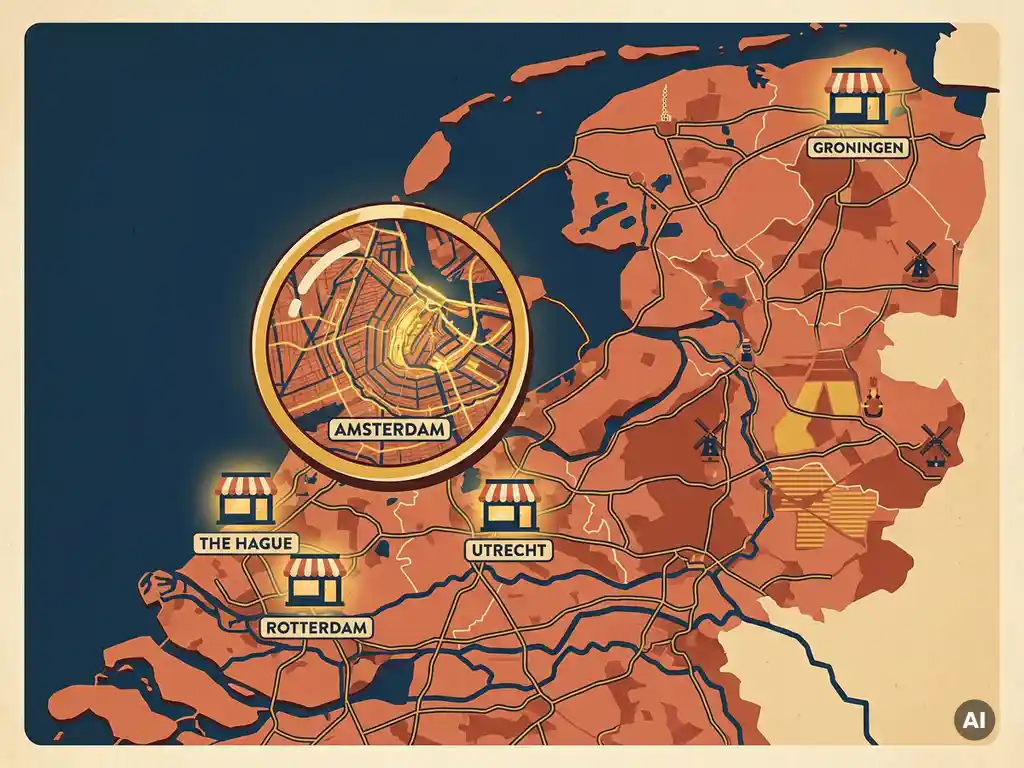
The most suitable cities for a new retail location in the Netherlands are Amsterdam, Rotterdam, Utrecht, The Hague, and Eindhoven. But whether a city suits your concept depends on more than just the number of inhabitants. Factors such as visitor density, rent levels, competition, and the composition of the retail area determine whether a location actually has a chance of success. This article answers the most frequently asked questions about choosing the right city and retail location for your retail concept.
What factors determine whether a city is suitable for a store?
A city is suitable for a retail location when there is a sufficient matching audience, rent levels are proportionate to the expected revenue potential, and there is room for your concept within the existing retail landscape. Support base, accessibility, and the strength of the retail area are the three pillars.
In concrete terms, this means looking at the following factors:
- Catchment area: How many people live or work within a realistic reach of the retail location?
- Visitor intensity: How many passers-by walk past the intended street or shopping centre on a daily basis?
- Competitive position: Are there already similar formulas present, or is there a gap in the offering?
- Rent level: Is the asking price proportionate to the turnover that is realistically achievable at that location?
- Accessibility: Is the location easily accessible by public transport, and does the area have sufficient parking facilities?
A city with a large population is not automatically the best choice. A smaller city with a loyal local customer base and low rental costs can perform considerably better for some concepts than an expensive prime location in a major city. Guidance on renting retail space therefore always starts with an analysis of your target audience and concept, not with the question of which city is the largest.
Which Dutch cities have the strongest retail demand?
The strongest retail demand in the Netherlands can be found in Amsterdam, Rotterdam, Utrecht, The Hague, and Eindhoven. These are the five largest cities in terms of catchment area, footfall, and retail turnover. In addition, cities such as Groningen, Maastricht, Tilburg, and Arnhem show stable to growing demand, depending on the segment.
Amsterdam remains the frontrunner due to tourism, high population density, and the international appeal of the city centre. Rotterdam is attracting an increasing number of lifestyle and design concepts thanks to the urban renewal of its centre. Utrecht has a compact but highly active city centre with a young, affluent population. Eindhoven positions itself as a design city and attracts brands that want to stand out.
Outside the Randstad, Groningen is an underrated market. The city has a large regional catchment area, an active student population, and a retail area that performs well compared to other provincial capitals. KroesePaternotte is active throughout the Netherlands and knows the market dynamics in all these cities at street level, including rental price data going back to 1984.
What is the difference between a prime, secondary, and tertiary location?
A prime location is a retail area with the highest footfall density and the strongest retail concentration, such as the main shopping streets in major cities. A secondary location has fewer passers-by but still has a functioning retail area. A tertiary location lies outside the primary retail areas and has limited footfall and lower rents.
The distinction has direct consequences for rent levels, revenue potential, and suitability for different retail concepts:
- Prime location: Highest rent per square metre, maximum visibility, suitable for formulas that depend on impulse purchases and brand awareness.
- Secondary location: Lower rental costs, stable customer flow, suitable for concepts with a loyal customer base or a specific target group that deliberately seeks it out.
- Tertiary location: Low rent, limited footfall, only suitable for destination stores with a strong online presence or specific services.
The choice between prime, secondary, or tertiary is not solely a matter of budget. An excessively low rent at a tertiary location can ultimately prove more expensive if turnover falls short. Conversely, a prime location can make exactly the difference for a concept that needs visibility to grow.
How do you know whether a specific shopping street suits your concept?
A shopping street suits your concept when the retail mix, the audience, and the character of the area align with what you sell and to whom. Look at the stores already present, the average spend in the area, and the demographic composition of visitors.
A practical way to assess this is to visit at multiple times during the week. How busy is it on a weekday morning versus a Saturday afternoon? Which age groups are walking around? Are the existing retailers complementary to your offering, or are they direct competitors? Does the character of the street align with the image you want to project?
In addition to your own observations, it is valuable to have access to footfall counts and rental price data per street. That information is not always publicly available, but through a specialised retail agent with a current location portfolio you gain insight into what a specific street is truly worth and what comparable locations yield.
When is a smaller city a better choice than a large city?
A smaller city is a better choice than a large city when your concept depends on repeat visits, local loyalty, or a lower cost structure. In smaller cities, rents are lower, competition from large chains is less intense, and it is easier to build a recognisable position.
Specific situations in which a smaller city is preferable:
- You sell products or services that people actively seek out and that do not depend on high footfall.
- You want to build a strong local reputation before expanding into larger markets.
- The target audience in the major cities is already well served by established players, while in smaller cities there is a clear gap in the offering.
- The rent in the major city is not proportionate to the realistic revenue potential for your concept.
Cities such as Zwolle, Breda, Nijmegen, and Haarlem have an attractive profile for retailers who deliberately opt for a strong regional position. They combine a stable catchment area with reasonable rents and an active retail area.
How can you have a retail location assessed before you sign?
Having a retail location assessed before you sign means commissioning an independent analysis of the rent, the contract terms, and the revenue potential of the location. This prevents you from signing a contract based on incomplete information or an overly optimistic estimate from the landlord.
A thorough assessment covers at least the following elements:
- Rent assessment: Is the requested rent in line with the market for this type of location in this city and street?
- Contract analysis: What are the term, the notice periods, the break options, and the indexation clauses?
- Location analysis: What are the footfall figures, the retail mix in the immediate vicinity, and the development direction of the area?
- Negotiation room: Is there scope to improve the rent or terms based on current market data?
KroesePaternotte carries out these kinds of assessments daily for retailers opening or expanding a retail location. With lease contract data going back to 1984 and active involvement in transactions throughout the Netherlands, the company provides a factual basis that makes it possible to negotiate on the basis of market knowledge rather than intuition. Get in touch for an initial conversation about your intended location, or find out more about the approach and background of KroesePaternotte.
Related Articles
- Can you transfer a commercial lease to another tenant?
- When should you hire a retail agent when looking for retail space?
- What are retail property yields in the Netherlands?
- What is indexation in a Dutch retail lease?
- Should you buy or rent a retail property as a retailer?
- What is the impact of online shopping on foot traffic in city centres?
- What are the strongest secondary retail cities in the Netherlands?
- How do you value a retail property in the Netherlands?