
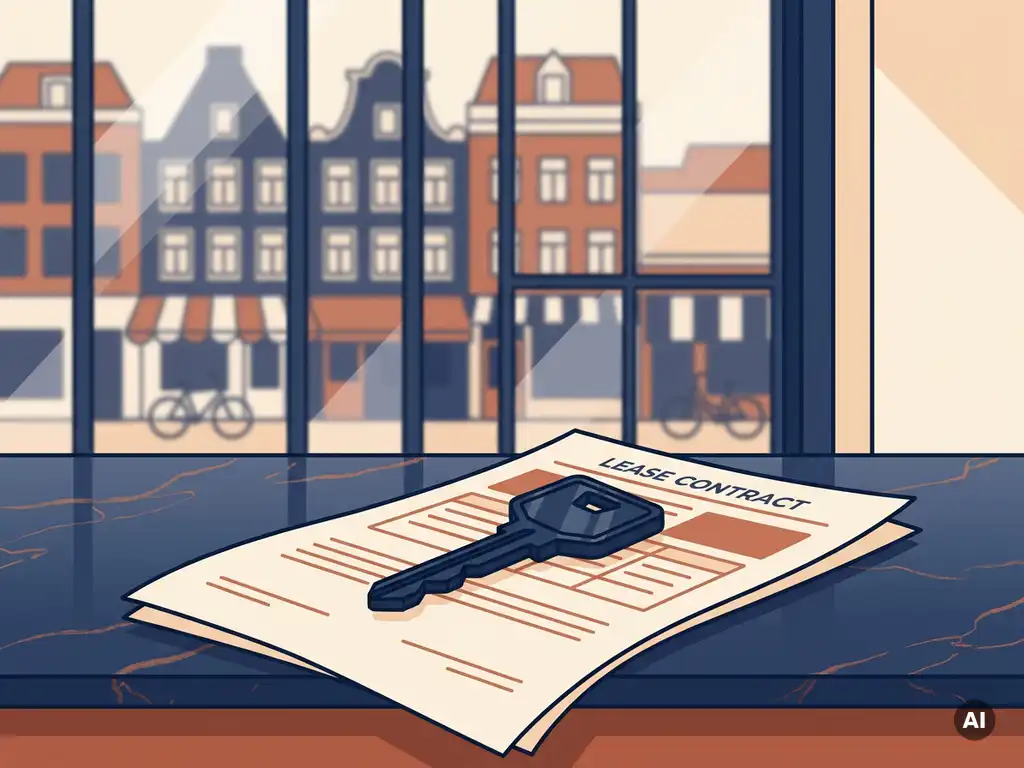
Terminating a retail space lease early is not simply possible in most cases. Retail space falls under the so-called 290 business premises law, which protects tenants but also binds them to fixed terms. Early termination requires either a contractual break option, agreement with the landlord, or a legal procedure. This article answers the most important questions about terminating a retail space lease, from statutory notice periods to negotiation tips.
What are the statutory notice periods for retail space?
For retail space, the law prescribes a lease period of five plus five years: an initial term of five years, followed by a renewal option of another five years. Interim termination by the tenant during these fixed terms is in principle not permitted, unless the contract explicitly provides for this. After the first ten years, a notice period of at least one year applies.
The law offers tenants of retail space relatively strong protection. However, this also means that as a tenant you are bound to the agreed duration. If you want to leave earlier, you are dependent on what has been contractually established or on the landlord’s willingness to cooperate. It is therefore advisable to already account for flexibility clauses when entering into a retail space lease, especially if you have a growing or changing concept.
What is a break option in a retail space lease?
A break option is a contractual provision that gives a tenant the right to terminate the lease at a predetermined point during the term, without further financial consequences. This option is included during negotiation of the lease and gives tenants a controlled exit if business circumstances change.
In practice, a break option looks like this: for example, you agree on a lease period of five years, with a break option after three years. If you want to stop at that point, you notify in time, typically with a notice period of six to twelve months. The break option is therefore not an automatic right, but a negotiable part of the contract. Landlords do not always accept this without conditions, but in a market where vacancy is a real risk, a well-substantiated request certainly has a chance of success.
When searching for retail space, it is advisable to have the contract terms assessed early in the process. Guidance on renting retail space at KroesePaternotte also includes assessing and negotiating such clauses, based on current market data.
Can a tenant vacate a retail space early without a break option?
Without a break option in the lease, a tenant cannot unilaterally vacate the retail space early. You remain legally bound to the duration of the lease and are in principle obligated to continue paying rent, even if you no longer use the premises. However, there are a number of practical alternatives.
- Subletting: With the landlord’s permission, you can sublet the premises to another party, so that the rental costs are covered.
- Assignment: You transfer the lease to a new tenant. The landlord must in principle cooperate if the new tenant is sufficiently solvent, although the court has the final say.
- Amicable termination: You negotiate with the landlord for an early termination, possibly in exchange for compensation.
A court can also dissolve the lease in cases of serious default by the landlord or unforeseen circumstances. However, this is a legally demanding process and not the usual route for a business owner who simply wants to relocate or close.
When can a landlord terminate the lease?
A landlord can terminate a retail space lease, but the law sets strict conditions for this. After the first lease period of five years, the landlord can terminate with a notice period of at least one year, but only on a number of legally defined grounds.
The most common grounds for termination by the landlord are:
- Urgent personal use: The landlord needs the space themselves, for example for renovation or their own business operations.
- Serious default by the tenant: Think of structural non-payment or nuisance.
- Failure to agree to a reasonable offer for a new contract: If the landlord wants new terms and the tenant refuses without good reason.
- Change of designated use: The municipality or government requires a different use of the location.
Termination by the landlord does not automatically result in an obligation to vacate. The tenant can object to the court, which then assesses whether the grounds for termination are valid. This gives tenants of retail space a strong legal position, but it also means that a dispute over termination can quickly become legally complex.
What does it cost to terminate a retail space lease early?
The costs of an early termination of a retail space lease depend heavily on the situation. If there is no break option and the landlord does not voluntarily cooperate, you as a tenant may be liable for the remaining rent payments over the entire contract period. This can quickly amount to tens of thousands of euros.
In practice, an amicable termination often involves an agreed buyout sum. This typically falls somewhere between three and twelve months’ rent, depending on the remaining term, demand for the location, and room for negotiation. At a popular A-location in a city such as Utrecht, Rotterdam, or Amsterdam, a landlord will be more willing to cooperate, as they can quickly re-let the space. At a less sought-after location, the landlord is less inclined to agree to a favorable arrangement.
Additional costs may include: legal costs if a procedure is necessary, costs for restoring the premises to their original condition, and any penalties included in the contract for early departure.
How do you negotiate an early termination of your lease?
Successfully negotiating an early termination of a retail space lease starts with a well-substantiated approach. Landlords are commercial parties: they think in terms of risk and return. If you offer them an acceptable alternative, the chance of an amicable settlement is real.
Practical steps that help:
- Come with a concrete proposal: Propose a buyout sum based on realistic market insight. A proposal of “three months’ rent” is stronger if you can substantiate why the location is quickly re-lettable.
- Find a successor: If you bring forward a new tenant yourself through assignment, you significantly reduce the risk for the landlord. This strengthens your negotiating position.
- Be transparent about your situation: Landlords prefer to cooperate with a controlled solution rather than having a tenant who no longer pays rent.
- Get support from a specialist: A retail agent or legal advisor who knows the market can assess what a realistic buyout sum is and negotiate on your behalf.
KroesePaternotte holds lease contract data from the Dutch retail market going back to 1984. That in-depth market knowledge makes it possible to work with concrete references rather than assumptions when negotiating terminations or new contracts. Whether you want to terminate a lease or are looking for a better location: get in touch for a no-obligation conversation.
Want to know what current retail space is available, including locations that never appear on public portals? KroesePaternotte, as a specialized retail agent in the Netherlands, is in daily contact with owners and developers of the best retail locations in the country. That network makes the difference, both in finding a new space and in settling an existing contract.
Related Articles
- What is the difference between renting through an estate agent or searching yourself?
- How to test a new retail location with a temporary pop-up?
- What are the best high streets to invest in the Netherlands?
- What are retail property yields in the Netherlands?
- How large is the vacancy rate in Dutch shopping streets?
- What is yield compression in Dutch retail real estate?
- How do location grades affect retail property pricing in the Netherlands?
- How does the Dutch retail property transaction process work?