
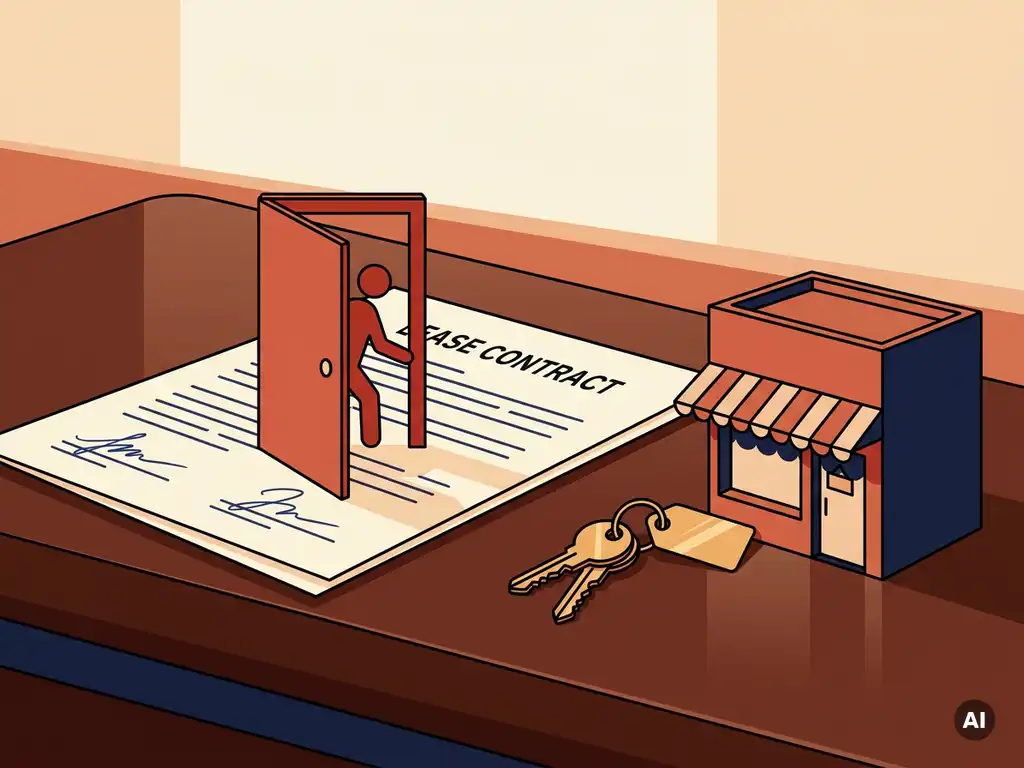
A break option in a retail lease is a contractual provision that allows the tenant (or landlord) to terminate the lease early at a predetermined point in time, without this being legally considered a breach of contract. For retailers, this is one of the most valuable clauses in a lease agreement, as retail locations sometimes fail to generate the expected turnover or because a business grows faster than anticipated. In this article, we answer the most frequently asked questions about the break option in a retail lease.
When can you exercise a break option?
A break option may be exercised at the moment stipulated in the contract, provided you observe the associated notice period. In practice, a break option is linked to a specific date, for example after the third year of a five-year lease. You must typically exercise the option in writing six to twelve months in advance.
The exact timing and procedure are set out in the lease agreement itself. Please note: a break option only works if you strictly adhere to the formalities. If you miss the notice deadline, the right lapses automatically and you continue until the next contract period. This is one of the most common and costly mistakes tenants make.
Some break options are also subject to conditions, such as having paid all rent in full or returning the premises to their original condition. If those conditions are not met, the landlord can challenge the exercise of the option. So make sure you not only exercise the option on the correct date, but also fulfil all associated obligations.
How does a break option differ from ordinary termination?
A break option differs from ordinary termination in that it is a contractually established right to terminate at a specific interim point, whereas ordinary termination is only possible at the end of the agreed lease period. Retail leases in the Netherlands are by default subject to a fixed term, making early termination without a break option legally almost impossible.
Commercial retail leases in the Netherlands fall under the regime of Article 7:290 of the Dutch Civil Code. This legal framework offers the tenant relatively strong protection, but at the same time limits flexibility. A tenant who has not negotiated a break option is in principle locked in for the full duration of the contract, unless landlord and tenant mutually agree to terminate.
A break option therefore gives you a contractual right that you can exercise unilaterally. Ordinary termination always requires mutual agreement or the expiry of the contract term. That difference is enormous in practice, especially for a retail entrepreneur who may face disappointing visitor numbers or changing market conditions.
What are the costs or conditions associated with a break option?
A break option almost always comes with conditions. The most common are a financial payment to the landlord, a minimum notice period of six to twelve months, and the obligation to return the premises to their original condition. Some landlords also stipulate that the tenant must have no rent arrears at the time of exercising the option.
The financial payment, also known as a break penalty or break fee, varies considerably. In some contracts this is a fixed amount; in other cases it amounts to a number of months’ rent. The higher the incentives were at the start of the contract (such as a rent-free period or a contribution towards the fit-out), the greater the likelihood that the landlord has built in a break fee to recoup their investment.
In addition to financial conditions, there are also practical obligations. Think of removing all alterations you have made as a tenant, restoring the space to its original condition, and timely handing over keys and documents. Failing to meet these obligations risks the break option being declared void or additional damage claims following.
How do you negotiate a break option into your lease?
A break option is best negotiated before signing the lease, as part of the overall lease negotiation. The key is to present the break option as a reasonable allocation of risk, not as distrust towards the landlord. Landlords are more willing to accept a break option if the other lease terms are attractive to them.
Practical negotiation tips:
- Propose a break option at a logical point, such as the third year of a five-year contract
- Offer a longer notice period in return, giving the landlord sufficient time to find a new tenant
- Accept a limited break fee if that clears the way for the clause
- Record the exact procedure in writing: date, method of notification, and conditions to be fulfilled
- Have the wording checked by a specialist, as vague language works against the tenant
Landlords of prime locations are generally less quick to offer a break option, as demand for those locations is high. Yet even there it is open for discussion, especially if you as a tenant bring a strong concept and a solid financial profile. Support with lease negotiations from a specialist retail agent makes a real difference here, as they know which landlords are open to this type of clause and how best to conduct the negotiation.
What risks are associated with a lease without a break option?
A retail lease without a break option binds you fully to the contract term, regardless of how turnover develops. If your location underperforms, your concept changes, or your business grows faster than expected, you have no legal way out. You are obliged to keep paying rent, even if you no longer use the space.
The concrete risks are considerable:
- Financial risk: In the event of underperformance, you remain liable for the full rent until the end of the contract period
- Strategic risk: You cannot respond to opportunities elsewhere, such as a better location that becomes available
- Insolvency risk: Without a break option, a loss-making location can put the entire business under pressure
- Subletting risk: Subletting as a way out is not always permitted and requires the landlord’s consent
In practice, we see that new retailers underestimate this risk, precisely because they are full of confidence at the start of the lease. But the retail market changes rapidly: consumer behaviour, footfall, and competition can shift significantly within a few years. A lease without any form of flexibility therefore represents a considerable business risk.
KroesePaternotte holds lease data covering virtually the entire Dutch retail market, going back to 1984. This knowledge makes it possible to assess, in every negotiation, which contract terms are in line with the market and where there is room for clauses such as a break option. Through the current retail space listings and direct contacts with owners and developers, we help retailers not only find the right location, but also sign the right contract. Want to know what is possible for your situation? Contact one of our retail specialists.
Related Articles
- What is typically included in a commercial lease agreement for retail space?
- What are the cheapest city centres to rent retail space?
- What determines the valuation of a retail property?
- How does e-commerce affect Dutch retail real estate?
- When do you need a valuation of retail property?
- What are the benefits of a pop-up shop as a first step offline?
- What drives rental growth in Dutch retail real estate?
- Can you transfer a commercial lease to another tenant?
- What drives rental income on retail property in the Netherlands?