
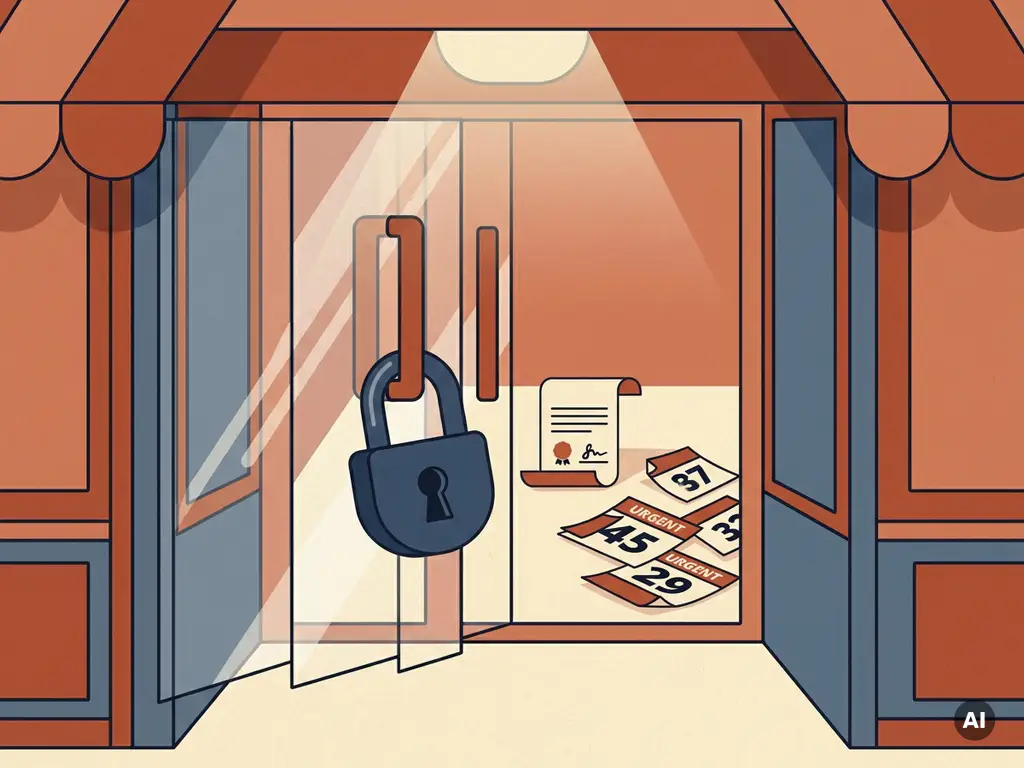
If you want to leave a retail space earlier than agreed, you essentially have three options: invoke a contractual break option, negotiate an amicable termination with the landlord, or find a subtenant to take over the remaining lease term. Which route is most feasible depends on what is stated in your lease agreement and the nature of your relationship with the landlord. The questions below provide a concrete answer for each situation.
What are your legal options if you want to leave early?
As a tenant of a retail space, you have three legal routes to terminate a commercial lease early: exercise a break option if it is included in the contract, reach a termination agreement with the landlord through mutual consent, or have the lease taken over by a third party through assignment or subletting. Without one of these three options, you are in principle bound to the full lease term.
Retail space falls legally under Article 7:290 of the Dutch Civil Code, the so-called 290-business premises. This type of lease has a statutory minimum term of five years, with an extension of another five years if notice is not given in time. That protection exists primarily for the tenant, but it also means you cannot simply leave without consequences. Terminating a retail lease outside the agreed moments constitutes a breach of contract in legal terms, unless there is an explicit contractual basis for doing so.
In practice, the picture is more nuanced. Landlords are by no means always served by a vacant property and are in many cases willing to talk. The outcome of such a conversation depends heavily on market conditions, the location, and how attractive your space is to a new tenant. In prime A-locations in cities such as Amsterdam, Rotterdam, or Utrecht, a new tenant is often found quickly, which strengthens the landlord’s negotiating position. In weaker locations, the landlord may actually welcome a settlement.
What is a break option and how does it work in a retail lease?
A break option is a contractual clause that gives a tenant the right to terminate the lease at a predetermined point during the term, without this being considered a breach of contract. In a retail lease, this moment is typically set after two or three years, with a notice period of six to twelve months. The break option for retail space must be explicitly included in the contract to be valid.
Break options are increasingly being included in lease contracts, particularly among retailers who are uncertain about their growth strategy or with new concepts that want to test whether a location works. For landlords, a break option is a concession, and they sometimes ask for something in return, such as a higher rent or a penalty upon exercise.
Pay close attention to the exact wording in the contract. A break option can only be exercised if you strictly comply with the stated conditions: the correct notice period, the correct written form, and sometimes additional requirements such as having met all payment obligations. If any of those conditions are not met, the right lapses. It is advisable to always exercise a break option in writing and to request confirmation from the landlord.
What happens if you leave without the landlord’s permission?
If you vacate a retail space before the end of the lease without the landlord’s permission and without a valid break option, you remain legally liable for rent payments until the end of the contract period. The landlord can compel you through the courts to pay the remaining rent, even if you are no longer using the property. This is the riskiest route.
In practice, a landlord will try to find a new tenant in the event of a vacancy, but is not obliged to do so. If a new tenant is found, your payment obligation ceases at the moment the new lease takes effect. If that does not succeed, the meter keeps running. Some landlords claim not only the rent but also compensation for lost income, costs for refurbishment, or marketing costs for re-letting the property.
In addition to the financial risks, leaving without consultation also damages the relationship with the landlord and can harm your reputation in the market. Real estate markets are small, especially in the retail sector. Landlords, agents, and shopping centre managers know each other. A poor payment history or a contentious departure can make it harder to rent a good location in the future.
Can you sublet a retail space if you want to stop yourself?
Subletting a retail space is in principle possible, but only if the landlord gives permission for this or if the lease explicitly allows it. Without permission, subletting retail space is in breach of the lease agreement and the landlord can dissolve the tenancy. An alternative is assignment, whereby a new tenant fully steps into your position and the landlord continues the lease with them.
Assignment is legally governed by Article 7:307 of the Dutch Civil Code. As a tenant, you have the right to ask the court to substitute a new tenant in your place, provided that new tenant offers sufficient guarantees for the performance of the contract. The landlord can object, but the court weighs the interests. This process takes time and money, and is not always the fastest solution.
Subletting without assignment, where you as the head tenant remain liable, is a different structure. You sublet the space to a third party, but you remain responsible for rent payments to the landlord. This reduces your financial burden but does not fully resolve the problem. Always check what the contract says about this and request written permission from the landlord before taking any steps.
How do you negotiate an early termination with the landlord?
Negotiating an early termination of a retail lease starts with a well-prepared approach: map out the remaining term, the rent level, and how attractive the location is to a new tenant. Landlords are more inclined to reach a settlement if they have a clear prospect of a good successor. If possible, offer a prospective tenant yourself as part of the negotiation.
A landlord will typically ask for compensation in the event of an early termination. That compensation is separate from formal legal liability and is the result of a commercial consideration. It is common for the tenant to pay a number of months’ rent as a buyout, depending on the remaining term and the prospects for re-letting. In an A-location on a busy shopping street, that compensation is often lower than in a location that is harder to let.
Make sure you record the negotiation in writing and have the final termination agreement reviewed legally. Verbally made agreements are difficult to enforce. A specialist retail agent or real estate advisor can support you in this process, especially if you have little experience with lease negotiations. Guidance with lease negotiations from a party that knows the market makes the difference between a costly exit and a workable solution.
What costs are involved in vacating a retail space early?
When vacating a retail space before the end of the lease, the following cost items may be relevant: a buyout payment to the landlord, ongoing rent payments until a new tenant is found, costs for restoring the space to its original condition (dilapidations), and any legal costs if a dispute arises. The total financial impact depends heavily on the remaining term and market conditions.
The dilapidations obligation is often underestimated. Most retail leases stipulate that you must return the space in the condition described in the contract, typically the condition at the start of the tenancy. This can mean that you must undo renovations, restore floors, or remove technical installations. The costs involved can be considerable, especially if you have made significant alterations to the property.
In addition to the direct costs, there are also indirect costs: time, energy, and attention that you cannot devote to your business. A well-structured exit strategy, ideally thought through when entering into the lease, significantly limits the damage. Those who already take into account flexibility clauses and break options when searching for retail space are in a much stronger position in the event of an early termination.
Would you like to know what your specific situation entails or do you need help assessing your lease? KroesePaternotte specialises in retail real estate and holds lease data covering virtually the entire Dutch retail market, going back to 1984. That knowledge makes it possible to advise quickly and concretely, whether it concerns an existing contract or a new location search. Contact us directly for a no-obligation conversation.
Related Articles
- What is the relationship between consumer spending and retail rents in the Netherlands?
- How do you assess retail tenant quality in the Netherlands?
- How does a retail property valuation work in the Netherlands?
- What determines the valuation of a retail property?
- What is a net initial yield in Dutch retail property?
- What is indexation in a Dutch retail lease?
- How large is the vacancy rate in Dutch shopping streets?
- What are the best high streets to invest in the Netherlands?
- How strong is the Dutch retail market in 2026?
- What are the most common mistakes in Dutch retail property investment?