
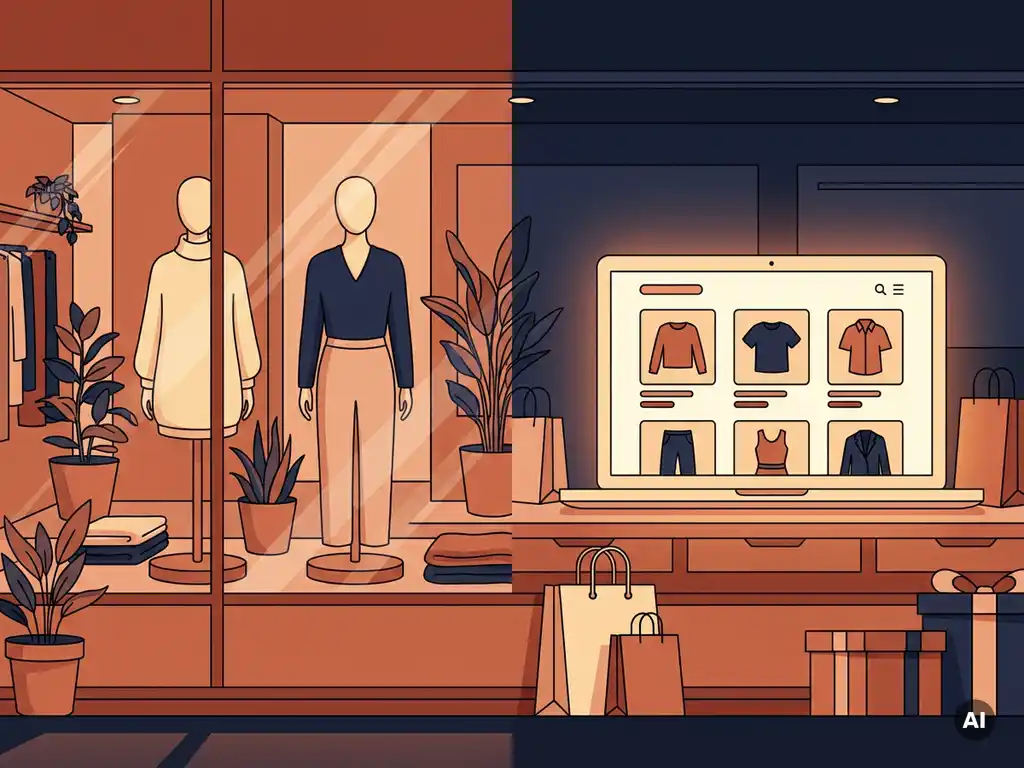
Combining a physical store with an online shop at the same location is not only possible, it is for many retailers the most efficient way to grow. You share costs for rent, staff and inventory, while reaching customers both online and offline. The sections below answer the most frequently asked questions about how to put this into practice.
What are the benefits of a combined store and online shop?
A combined store and online shop at one location lowers your operational costs, increases your visibility and strengthens customer trust in your brand. You pay one rent, manage one inventory and build two channels at the same time. For growing retailers, this model in 2026 is one of the most profitable ways to have a physical presence without double overhead.
The biggest advantage is the shared infrastructure. Your warehouse, your till and your staff serve both the in-store customer and the online buyer. That means less waste and a higher occupancy rate of the space you are already renting. Moreover, the channels reinforce each other: customers who know your brand online are more likely to walk into a physical store, and in-store customers order online more often after a positive in-store experience.
A second advantage is brand credibility. A physical address immediately gives your online shop more authority. Customers know there is a place where they can go with questions or returns. That lowers the threshold to buy online, especially for new customers who are not yet familiar with your brand.
How do you set up a retail space for both retail and logistics?
You set up a combined space by creating a clear separation between the customer zone and the work zone. The sales floor is designed for experience and conversion; the rear part of the space, or a separate storage room, serves as a warehouse for online shop orders. How you make that division depends on the floor area and the type of product you sell.
In practical terms, you need at minimum: a screened-off picking area with shelving or bins per product category, a packing station with packaging materials and a printer for shipping labels, and a system to track incoming and outgoing orders. For smaller spaces, a compact storage wall or a mobile rack already works well.
When designing the layout, also take into account the customer’s walking route. Visible logistics activities can disrupt the shopping experience. A light partition wall, a curtain or a clear transition between zones is often enough to keep both worlds separate without major renovations.
What is click-and-collect and how do you set it up?
Click-and-collect is an ordering option whereby customers buy a product online and then collect it at the physical store. It combines the convenience of online shopping with the certainty of personal collection, without shipping costs. For omnichannel retailers, it is one of the most effective ways to connect online and offline traffic.
To set up click-and-collect you need three things: an online shop with a collection option at checkout, a real-time inventory link so that customers can only order what is actually available in the store, and a clear internal process for reserving and preparing orders. The latter is simpler than it sounds: a separate rack or compartment with the customer’s name is sufficient for many stores.
Setting up click-and-collect therefore does not start with technology, but with logistics. First make sure your inventory is reliably tracked before you activate the option in your online shop. Nothing undermines a customer’s trust faster than an order that turns out to be unavailable when they come to collect it.
Which systems do you connect to synchronise a store and online shop?
To synchronise a store and online shop you connect at least three systems: a point-of-sale system (POS), an online shop platform and an inventory management system. When these three communicate with each other, sales in the store are automatically processed in the online inventory and vice versa. Without this connection, inventory discrepancies arise that lead to errors in orders and frustrated customers.
The most commonly used combinations in 2026 are a cloud-based point-of-sale system that connects via an API to an online shop platform. Many modern systems offer this integration as standard, or via a connector tool. Preferably choose systems that synchronise in real time, not once a day, so that your inventory is always up to date on both channels.
In addition to the technical connection, it is also important to have your product data in order. Every product needs a unique barcode or SKU that is the same across all systems. That may sound obvious, but in practice inconsistent product data is one of the most common causes of synchronisation problems for retailers making the move to omnichannel.
What location requirements apply to an omnichannel retail concept?
An omnichannel retail concept places specific demands on the location: sufficient floor space for both a sales floor and a logistics workspace, good accessibility for customers who come to collect, and a loading and unloading zone for parcel services. Not every prime location automatically meets these requirements, and that makes location selection for omnichannel retailers more complex than for a purely physical store.
Accessibility is a key factor. Customers who come to collect want to be able to park quickly or reach the space easily by public transport. A location deep in a shopping street without parking may be less suitable for click-and-collect than a property on the edge of a shopping centre with direct access.
In addition, the rear of the property plays a role. Daily deliveries of parcels and returns require a functional access point for couriers, preferably out of sight of the in-store customer. In compact city-centre properties that is not always possible, but it is a point you need to raise with the landlord in advance.
For retailers looking for their first omnichannel location, it is advisable to seek location advice from a specialist who knows the market well. Guidance with renting retail space from a specialised retail agent gives you insight into which locations are suitable for your concept, including properties that never appear on public portals.
What does a lease agreement say about using the space for fulfilment?
A standard lease agreement for retail space specifies the permitted use of the space, and fulfilment for an online shop does not automatically fall within that scope. If the lease only mentions “retail” or “retail activities” as the designated use, the landlord may object to using part of the space as a warehouse or dispatch centre. It is essential to establish this in writing in advance.
When negotiating the contract, explicitly request a description of use that covers both physical sales and e-commerce fulfilment. Formulate this as concretely as possible, for example: “retail trade and the storage and dispatch of goods for the purpose of online sales.” The more specific the description, the less room for dispute afterwards.
Also pay attention to clauses about noise nuisance, opening hours and loading and unloading. If parcel services come by daily outside regular store hours, that must be contractually permitted. Landlords of retail properties in shopping centres sometimes apply strict rules about delivery times and access to the loading zone.
Those who are unfamiliar with the legal details of a retail lease agreement run the risk of clauses that prove restrictive later on. Contact KroesePaternotte for guidance in reviewing lease terms and conditions. As a specialised retail agent in the Netherlands, KroesePaternotte assesses lease agreements on the basis of current market data and years of experience with retail property, so you know what is market-standard and what to look out for before you sign.
An omnichannel retail concept requires a location and a contract that support both channels. Those who arrange this properly in advance lay a solid foundation for growth in both the physical and the online world. View the current retail listings or read more about the approach of KroesePaternotte to see how they guide retailers in finding the right location.
Related Articles
- What is a net initial yield in Dutch retail property?
- What investment opportunities exist on the PC Hooftstraat?
- What is the impact of online shopping on foot traffic in city centres?
- What is a 303 valuation in the Netherlands?
- What is the difference between high street and shopping centre investment?
- What is the role of footfall in Dutch retail property valuation?
- What are the strongest secondary retail cities in the Netherlands?
- What is the Dutch retail real estate market?