
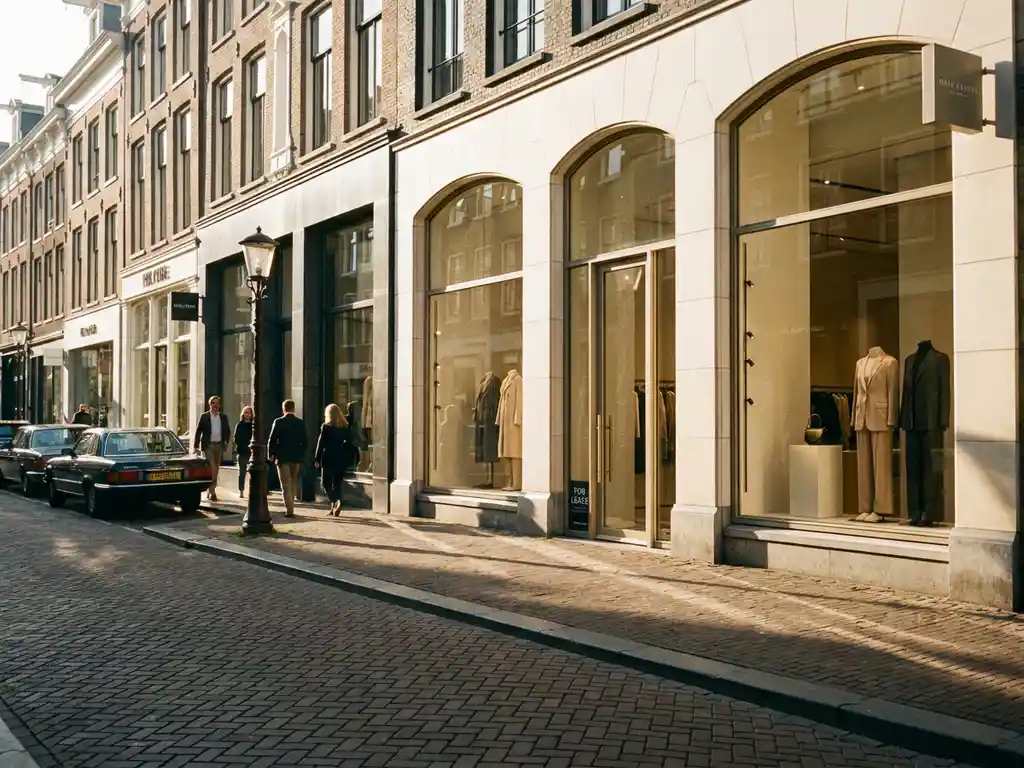
The PC Hooftstraat in Amsterdam is one of the most compelling luxury retail investment opportunities in the Netherlands, offering stable long-term income from internationally recognised luxury tenants in a supply-constrained, high-demand location. For international investors, the street represents a rare combination of brand-name occupier quality, low vacancy risk, and a transparent legal framework. The sections below address the most important questions any serious investor should ask before committing capital to this market.
Who are the typical tenants on the PC Hooftstraat?
The PC Hooftstraat is home to an almost exclusively luxury and premium retail tenant base, including global fashion houses, jewellers, and lifestyle brands. Occupiers such as Louis Vuitton, Gucci, Hermès, Chanel, Burberry, and Porsche Design anchor the street, alongside premium Dutch and European concepts. Vacancy is structurally low because demand from luxury brands consistently outpaces available supply.
This tenant profile is significant from an investment perspective. Luxury brands treat their physical stores as brand assets, not just revenue channels, which means they tend to commit to longer lease terms and invest heavily in fit-out. Turnover-driven rent clauses are common in this segment, which can provide upside exposure to retail performance beyond the base rent. The occupier covenant quality on the PC Hooftstraat is among the strongest of any retail street in the Netherlands, comparable to the premium high streets of Paris, Milan, and London.
Understanding which tenants are currently expanding, which are renegotiating, and what the re-letting pipeline looks like requires live market intelligence rather than published reports. Retail leasing expertise grounded in active transaction data is essential for assessing occupier quality at the individual unit level.
What rental levels and yields can investors expect on the PC Hooftstraat?
Prime rents on the PC Hooftstraat are among the highest in the Netherlands and are broadly comparable to other top-tier European luxury streets, though below the absolute peaks of Bond Street or Avenue Montaigne. Net initial yields on prime assets are low, reflecting the strong occupier covenant and scarcity of available product. Investors should expect prime high street yields in Amsterdam to sit in a compressed range relative to secondary Dutch retail locations.
Yield levels are influenced by several factors specific to the Dutch retail real estate market. Lease indexation in the Netherlands is typically linked to the consumer price index, which provides a degree of income protection during inflationary periods. However, the relationship between passing rent and market rent matters enormously. Assets where the passing rent significantly exceeds current market rent, a condition known in Dutch practice as overhuurde, carry real reversionary risk that must be priced into any acquisition.
KroesePaternotte maintains a lease contract database covering virtually the entire Dutch retail market going back to 1984, which means yield and rent substantiation are grounded in actual transaction evidence rather than estimates. For investors seeking defensible underwriting, that depth of data makes a material difference. More detail on the investment landscape is available through retail investment advisory services covering the full transaction cycle.
How does Dutch lease law affect PC Hooftstraat investments?
Dutch lease law provides strong tenant protections that directly affect investment returns and asset management flexibility. The most important mechanism for investors to understand is the huurprijsherziening, or market rent review under Article 7:303 of the Dutch Civil Code. This process allows either party to request a rent adjustment to market levels every five years, based on a comparison with similar transactions. It is not a simple upward-only review and can result in rent reductions if market rents have fallen.
On the PC Hooftstraat, where rents have historically been supported by strong demand, the 303 process is less likely to produce downward pressure than on secondary streets. However, investors must still understand the methodology applied by Dutch valuers when substantiating comparable evidence, particularly the weighting of zone A rents and the treatment of incentives such as rent-free periods. The NVM valuation methodology and NRVT certification standards govern how these assessments are conducted.
Lease terms in the Netherlands are typically structured as five plus five year agreements, and tenants benefit from significant statutory renewal rights. This limits an owner’s ability to reposition an asset through tenant change in the short term, which is a structural feature of the Dutch market that international investors sometimes underestimate. Valuation and rent review expertise is critical to navigating these processes correctly.
What are the main risks of investing on the PC Hooftstraat?
The primary risks of investing on the PC Hooftstraat are pricing risk, reversionary rent risk, and the illiquidity of the investment market itself. Because available assets are scarce and investor appetite is persistent, there is a real danger of overpaying for an asset where the current rent is above sustainable market levels. Liquidity is also limited: the PC Hooftstraat is a short street with a finite number of investable lots, and finding a buyer at the right moment is not guaranteed.
E-commerce has had a more limited impact on luxury retail than on mass-market retail, but it is not irrelevant. Luxury brands continue to prioritise flagship physical locations, and the PC Hooftstraat benefits from strong international tourist footfall as well as domestic affluent consumer demand. Nevertheless, any structural shift in luxury brand distribution strategy would affect occupier demand on streets like this more acutely than diversified retail locations.
A further risk specific to the Dutch retail real estate market is the overhuurde condition mentioned above. An asset acquired at a passing rent that is materially above market rent faces a 303 review risk that could compress net operating income significantly at the next review cycle. Investors unfamiliar with the Dutch rent review process have historically mispriced this risk. Thorough due diligence, including an independent assessment of current market rent relative to passing rent, is non-negotiable.
How does the PC Hooftstraat compare to other European luxury high streets?
The PC Hooftstraat is a genuine European luxury high street, but it operates at a different scale and depth of market than Bond Street in London, Rue du Faubourg Saint-Honoré in Paris, or Via Montenapoleone in Milan. Rents and capital values are lower in absolute terms, which means the entry price for institutional quality assets is more accessible. However, the investment market is thinner, and exit options are more limited compared to the largest European luxury retail markets.
From a fundamentals perspective, the Netherlands offers a stable, transparent legal framework, a high-income consumer base, and a well-functioning regulatory environment for real estate investment. Dutch retail investment volumes rose significantly in 2025, and the outlook for 2026 reflects continued cautious optimism among institutional investors. The PC Hooftstraat benefits from Amsterdam’s position as a major European city with strong international tourism and a concentrated affluent residential catchment.
Where the street lags behind its European peers is in the depth of occupier demand. The pool of luxury brands seeking space in Amsterdam is smaller than in Paris or London, which means vacancy, when it does occur, can take longer to resolve. This makes tenant covenant quality and remaining lease term even more important variables in any acquisition analysis of the Netherlands high street retail investment market.
What should international investors verify before acquiring a PC Hooftstraat asset?
Before acquiring a PC Hooftstraat asset, international investors should verify the current market rent relative to passing rent, the remaining lease term and tenant renewal intentions, the structural condition of the building, the planning and heritage constraints on the property, and the realistic re-letting prospects in the event of vacancy. Each of these factors can materially affect the risk-adjusted return of the investment.
- Market rent substantiation: Confirm that the passing rent is supported by comparable transaction evidence, not just asking rents. An independent 303 valuation provides the most defensible basis.
- Lease documentation: Review the full lease for indexation clauses, break options, tenant improvement obligations, and any side agreements that affect the headline rent.
- Tenant covenant: Assess the financial strength of the occupying entity, not just the brand. Some luxury brands lease through subsidiary entities with limited balance sheet strength.
- Re-letting risk: Understand the realistic alternative tenant pool for the specific unit size and configuration. Not all units on the street are equally lettable to luxury brands.
- Building condition and capex: Heritage buildings on the PC Hooftstraat can carry significant maintenance obligations and restrictions on alteration that affect both cost and flexibility.
- Exit market depth: Consider who the likely buyers are in three to seven years and what yield assumptions underpin the exit scenario.
International investors entering the Dutch retail real estate market for the first time benefit significantly from working with a local specialist who has been active in both the leasing and investment markets simultaneously. Retail market research grounded in live transaction data provides the granular intelligence that published reports cannot replicate. KroesePaternotte has advised on retail investment transactions across the Netherlands since 1984, with active involvement in leasing, valuations, and acquisitions that produces a level of market intelligence no generalist firm can match. For investors evaluating a PC Hooftstraat acquisition, that local depth is the difference between a well-priced entry and an expensive lesson in Dutch retail market dynamics.
Related Articles
- How long is a typical lease term for a retail property?
- What does a retail property agent do differently from a regular estate agent?
- How many locations are profitable for a growing retail chain?
- What are the risks of investing in Dutch retail property?
- What is yield compression in Dutch retail real estate?
- What is the difference between a pop-up store and a permanent retail space?
- What are typical cap rates for Dutch retail property?
- What is the RICS standard and why does it matter for retail valuations?
- How does Utrecht compare to Amsterdam for retail investment?