
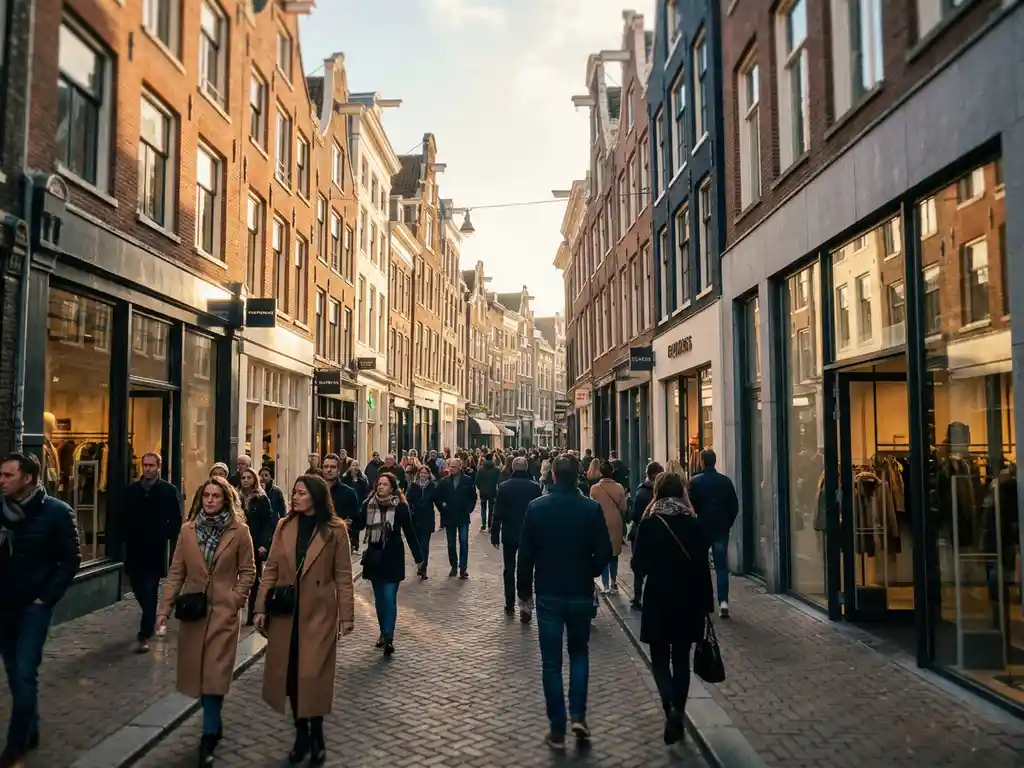
The Kalverstraat is Amsterdam’s premier high street and one of the most visited retail locations in the Netherlands. Stretching through the historic city centre, it consistently records among the highest pedestrian footfall figures in the country, making it a benchmark address for both national and international retailers. This article examines what defines the Kalverstraat as a prime retail street, how it performs commercially, and what investors need to understand before approaching this market.
Where is the Kalverstraat and what makes it unique?
The Kalverstraat is a pedestrianised shopping street in the heart of Amsterdam, running roughly from Dam Square in the north to Muntplein in the south. It is unique because it combines genuine historic character with consistently high consumer traffic, anchored by its central position within one of Europe’s most visited cities. No other Dutch shopping street operates at this intersection of tourism, urban density, and retail heritage.
The street’s pedestrian-only status concentrates foot traffic in a way that few European city centres can replicate. Its position adjacent to major cultural landmarks and public transport connections means that consumers arrive from multiple directions throughout the day. For retailers, this translates into extended dwell time and broad demographic reach, from local Amsterdammers doing everyday shopping to international visitors seeking flagship brand experiences.
What further distinguishes the Kalverstraat is its depth of retail history. The street has functioned as a commercial axis for centuries, and that continuity has shaped a landlord and tenant culture that is well established and relatively transparent. For investors assessing prime retail locations in the Netherlands, the Kalverstraat represents the clearest expression of what an A1 location means in the Dutch context: the best footfall, the strongest tenant demand, and the lowest vacancy risk.
How busy is the Kalverstraat compared to other Dutch shopping streets?
The Kalverstraat consistently ranks as one of the busiest shopping streets in the Netherlands by pedestrian count. Footfall on the Kalverstraat regularly exceeds that of comparable high streets in cities such as Rotterdam, Utrecht, and The Hague, placing it in a category of its own within the Dutch retail landscape. On peak days, the street draws hundreds of thousands of visitors.
Dutch footfall trends vary significantly by location type. While many secondary and tertiary shopping streets across the Netherlands have experienced structural footfall decline in the years following the pandemic, prime locations in Amsterdam have proven considerably more resilient. The Kalverstraat benefits from a dual demand base: domestic consumers and international tourists, which provides a buffer that purely local streets do not have.
This footfall advantage is not simply a function of Amsterdam’s size. It reflects the street’s physical configuration, its connectivity to public transport, and the density of retail offerings concentrated in a relatively short stretch. Investors evaluating footfall trends on Dutch shopping streets should treat the Kalverstraat as a distinct category rather than a scaled-up version of a regional high street.
What types of retailers are found on the Kalverstraat?
The Kalverstraat is dominated by national and international fashion and lifestyle retailers, alongside footwear, accessories, and personal care brands. The tenant mix reflects the street’s mass-market positioning: it attracts high-volume, accessible brands rather than luxury or niche operators. Fast fashion, sportswear, and mid-market apparel are the dominant categories.
Major international retailers with a presence on or immediately adjacent to the Kalverstraat include global sportswear brands, international fast fashion groups, and established European apparel chains. Dutch retail groups are also well represented. The street does not function as a luxury corridor in the way that the nearby PC Hooftstraat does, but its volume and visibility make it the preferred location for brands that prioritise reach over exclusivity.
Food and beverage retail has grown in prominence along the street and its immediate surroundings, reflecting a broader trend across European high streets where experiential and convenience formats fill space that pure fashion retail no longer occupies alone. For investors assessing tenant quality, the concentration of well-capitalised international operators on the Kalverstraat is a meaningful indicator of covenant strength relative to other Dutch retail locations.
What are typical rent levels on the Kalverstraat?
Rent levels on the Kalverstraat are among the highest in the Netherlands, reflecting its status as the country’s premier mass-market high street. Prime rents on the best pitches command a significant premium over comparable streets in other Dutch cities, and even over secondary sections of the Kalverstraat itself. Exact rent levels vary by unit size, configuration, and lease terms, but the street consistently sits at the top of the Dutch high street rental hierarchy.
Understanding rent levels on the Kalverstraat requires familiarity with Dutch lease law, particularly the process of huurprijsherziening (market rent review) under Article 7:303 of the Dutch Civil Code. Rents are reviewed against a five-year average of comparable market transactions, which means that current asking rents and contracted rents can diverge significantly depending on when a lease was last reviewed. This is a critical distinction for investors assessing whether an asset is correctly priced.
The risk of overhuurde property (where contracted rent exceeds current market rent) is real on any Dutch high street, including the Kalverstraat. Investors who lack access to granular transaction data on actual rents achieved, not just asking rents, are exposed to this risk. Specialist retail valuations that draw on verified lease data are essential for any serious due diligence process.
How does the Kalverstraat compare to other European prime high streets?
The Kalverstraat is a strong European high street by footfall and tenant quality standards, but it operates at a different scale and positioning than the very top tier of European retail streets such as Oxford Street in London or the Champs-Elysees in Paris. Its strength lies in its reliability and depth of demand rather than its luxury positioning or global brand flagship status.
Within the context of the Netherlands, the Kalverstraat has no direct equivalent. The PC Hooftstraat targets a different, higher-end consumer segment. Regional high streets in Rotterdam, Utrecht, and Eindhoven serve important markets but operate at lower footfall and rental levels. The Kalverstraat occupies a specific and well-defined position: the highest-volume, most commercially active mass-market retail street in the country.
For international investors comparing Dutch retail real estate yields with other European markets, the Kalverstraat is the clearest reference point for prime high street yield benchmarking in the Netherlands. Net initial yields on prime Kalverstraat assets reflect investor confidence in the location’s durability, though yield levels remain sensitive to lease structure, tenant covenant, and the broader interest rate environment.
What risks should investors consider when buying on the Kalverstraat?
Investing on the Kalverstraat carries risks that are specific to the Dutch retail market and to the street’s particular dynamics. The key risks include overhuurde lease structures, e-commerce pressure on certain retail categories, the complexity of Dutch rent review legislation, and the potential for significant price variation between the best and worst pitches on the same street.
The distinction between an A1 pitch and a secondary position on the Kalverstraat is not trivial. Footfall drops meaningfully as you move away from the core section of the street, and tenant demand follows. An asset that appears to be on the Kalverstraat may, in practice, sit in a materially weaker micro-location, which affects both rental income stability and re-letting prospects.
E-commerce has had an uneven impact on Dutch retail real estate. Categories such as consumer electronics and mid-market fashion have experienced structural pressure, while food, personal care, and experiential retail have proven more resilient. Investors need to assess not just the current tenant but the likely depth of demand from alternative tenants if the current lease is not renewed.
Dutch-specific legal and valuation considerations add another layer of complexity. The 303 rent review process, indexation mechanics, and the methodology used to substantiate market rent in a Dutch court all require specialist knowledge. International investors who approach the Kalverstraat without local advisory support risk misreading both the asset’s income security and its realistic yield trajectory. KroesePaternotte has been advising on Dutch retail investment transactions since 1984, with a lease transaction database covering virtually the entire Dutch retail market. That depth of market intelligence is what separates defensible investment decisions from ones based on incomplete data.
For investors seeking structured support across the full transaction cycle, from acquisition search through to yield substantiation and asset optimisation, retail investment advisory grounded in live market data is the most reliable way to navigate the Kalverstraat and the broader Dutch retail property market.
Related Articles
- How long is a typical lease term for a retail property?
- What does a retail property agent do differently from a regular estate agent?
- What are the risks of investing in Dutch retail property?
- What is the difference between a pop-up store and a permanent retail space?
- What does overhuurde mean in Dutch retail property?
- How do you assess the quality of a Dutch retail location?
- How do you spot a retail property with growth potential in the Netherlands?
- What is the difference between prime and secondary retail locations?
- What is the difference between a solitaire retail object and a shopping centre?