
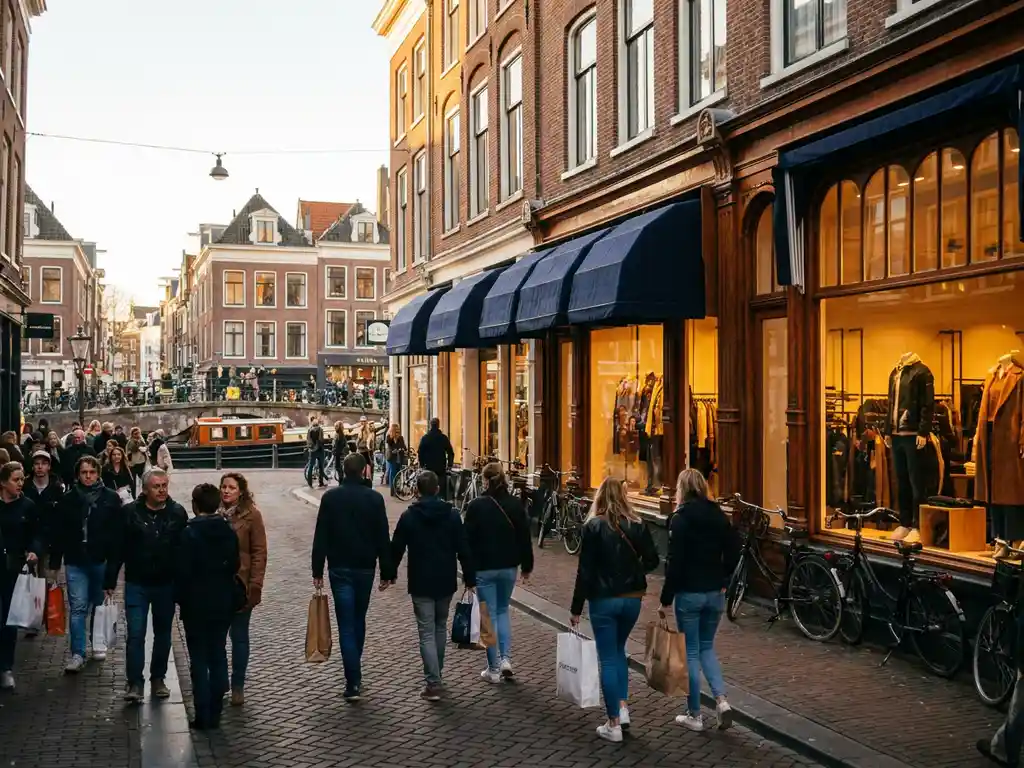
The strongest high streets for retail investment in the Netherlands are concentrated in Amsterdam, Rotterdam, Utrecht, and Den Haag, with Amsterdam’s PC Hooftstraat and Kalverstraat representing the country’s prime end of the market. That said, the best investment opportunity depends on your target yield, risk tolerance, and asset strategy. The sections below unpack location quality, yield dynamics, lease law, and the cities now drawing serious institutional attention.
Which Dutch high streets deliver the strongest retail investment returns?
Amsterdam’s PC Hooftstraat and Kalverstraat consistently deliver the strongest fundamentals for high street retail investment in the Netherlands, followed by prime pitches in Rotterdam (Lijnbaan and Koopgoot), Utrecht’s Hoog Catharijne surroundings, and Den Haag’s Spuistraat corridor. These locations combine high footfall, low vacancy, strong tenant covenants, and proven rental income stability, the combination that defines a defensible retail investment.
Beyond the headline names, returns depend heavily on how precisely you define “prime.” The Netherlands has a well-established hierarchy of retail locations, and the gap in performance between the top pitch on a street and a secondary position 200 metres away can be dramatic. Investors who understand this granularity consistently outperform those who rely on city-level generalizations.
Investment volumes in Dutch retail real estate rose significantly in 2025, reflecting renewed confidence in the asset class after years of repricing. For 2026, the outlook remains cautiously positive, particularly for well-let assets in proven locations. Retail investment advisory that draws on live leasing and valuation data is essential to identifying which specific assets within these locations are correctly priced.
What makes a Dutch high street an A1 location versus a B-location?
An A1 location in the Netherlands refers to the highest-footfall, most commercially active stretch of a shopping street, typically the section with the greatest pedestrian density, strongest brand presence, and lowest vacancy. A B-location sits outside this prime zone, often on a parallel street, a secondary entrance, or a lower-traffic section of the same street. In Dutch retail real estate, this distinction has direct consequences for rental levels, vacancy risk, and investability.
The classification is not simply about prestige. A1 locations in the Netherlands attract national and international retailers willing to pay premium rents because the commercial return justifies it. B-locations face structurally weaker demand, longer void periods when a tenant vacates, and greater sensitivity to consumer spending cycles. The difference in net initial yield between an A1 and a B-location in the same city can be 150 to 250 basis points, a gap that reflects genuine risk, not just perception.
For international investors unfamiliar with the Dutch market, correctly identifying A1 positions requires local intelligence that goes beyond map data or general market reports. Footfall patterns, tenant mix, anchor proximity, and the direction of pedestrian flows all determine where the true prime pitch sits. This is precisely where a specialist with decades of leasing market knowledge across every major Dutch city adds measurable value.
How do Dutch high street yields compare across major cities?
Prime high street retail yields in the Netherlands vary meaningfully by city and location quality. Amsterdam’s PC Hooftstraat typically commands the tightest yields, reflecting its status as the country’s most internationally recognized luxury retail destination. Rotterdam, Utrecht, and Den Haag prime pitches trade at slightly wider yields, offering more income return for investors comfortable with those markets. Secondary cities such as Groningen, Eindhoven, and Maastricht present wider yields again, with correspondingly higher risk-adjusted return potential.
As a general orientation for 2026, prime net initial yields on Dutch high street retail range from approximately 4% at the very top end of the Amsterdam market to 6% or above in strong regional cities. These figures shift with interest rate movements, capital availability, and asset-specific factors such as lease term, tenant covenant, and rent review structure. Yield compression seen during the low-rate era has partially reversed, which has created re-entry opportunities for investors who were priced out of the market in earlier cycles.
Comparing cap rates across Dutch retail property requires care. A headline yield on a Dutch high street asset may look attractive but can mask overhuurde risk (where the passing rent exceeds market rent), short lease terms, or upcoming rent review exposure. Substantiating whether a yield is genuinely defensible requires a full assessment of the lease structure and current market rent, the kind of analysis covered under Dutch retail valuations and rent reviews.
What risks should international investors assess before buying a Dutch high street asset?
The primary risks for international investors entering Dutch high street retail are location misjudgement, overhuurde exposure, lease structure complexity, and e-commerce-driven demand shifts. Each of these risks is manageable with the right local intelligence, but each has caught out cross-border investors who relied on generalist due diligence.
- Location risk: The difference between an A1 and a B-location in Dutch retail is extreme. Vacancy rates on secondary pitches can be multiples of those on prime streets, and re-letting timelines are far longer. Buying even one block away from the prime pitch in a city like Den Haag or Utrecht can fundamentally change the asset’s income resilience.
- Overhuurde risk: If the passing rent on an asset exceeds the current market rent, a tenant can invoke a 303 rent review (huurprijsherziening) and force a downward adjustment. This is a legally embedded mechanism in Dutch lease law and directly threatens projected income. Identifying overhuurde assets before acquisition is non-negotiable.
- Tenant covenant quality: Not all retail tenants in the Netherlands carry the same covenant strength. Assessing which tenants are expanding, which are under pressure, and which formats are structurally resilient requires current leasing market intelligence, not just a credit report.
- E-commerce impact: Dutch consumers are among Europe’s most active online shoppers. This has accelerated the bifurcation between experiential, destination retail (which holds well) and commodity retail (which faces ongoing structural pressure). Asset selection must account for which retail category the tenant occupies.
- Vacancy and re-letting timelines: Dutch shopping street vacancy rates vary considerably by city and pitch. Understanding realistic re-letting timelines and achievable market rents in a specific location requires access to actual transaction data, not published indices alone.
How does Dutch lease law affect high street retail investment income?
Dutch retail lease law directly shapes investment income through three mechanisms: the huurprijsherziening (market rent review under Article 7:303 of the Dutch Civil Code), annual indexation, and fixed lease term structures. Understanding how these interact is essential for any investor projecting income from a Dutch high street asset.
The 303 rent review allows either landlord or tenant to request a market rent assessment after a minimum lease period, typically five years. If the market rent has moved materially below the passing rent, a tenant can use this mechanism to reduce their obligation. This is the overhuurde risk referenced above, and it is one of the most common sources of income disappointment for investors who did not price it in at acquisition. Conversely, if market rents have risen, landlords can use the same mechanism to capture upside.
Annual indexation in Dutch retail leases is typically linked to the Dutch consumer price index (CPI). This provides a degree of income protection in inflationary environments, but it does not substitute for genuine market rent growth. In locations where footfall and tenant demand are structurally strong, market rent growth can outpace indexation over time. In weaker locations, indexation may mask the underlying erosion of real rental value.
Lease terms in Dutch retail are commonly structured as five-plus-five-year agreements, with renewal options. The remaining lease term at the point of acquisition is a critical variable in pricing: a long unexpired term with a strong tenant is a different investment proposition from a short-term lease in a location where re-letting risk is real. KroesePaternotte’s database of lease contract data across the Dutch retail market, extending back to 1984, provides the benchmarking depth needed to assess whether a passing rent and lease structure are investment-grade.
Which Dutch cities are emerging as high street investment opportunities?
Beyond Amsterdam, Rotterdam, Utrecht, and Den Haag, several Dutch cities are attracting increased investor attention in 2026 based on improving retail fundamentals, yield spreads relative to prime, and structural demand drivers. Eindhoven, Groningen, Maastricht, and Breda stand out as cities where high street retail investment merits serious consideration.
Eindhoven has benefited from strong population growth, a young and high-income demographic, and a retail core that has maintained occupancy well. The city’s position as a technology and design hub supports consumer spending and attracts quality retail tenants.
Groningen is the dominant retail destination for the northern Netherlands, serving a large catchment with limited competing centres. Its prime shopping streets have shown resilience in occupancy and tenant quality, and yields remain wider than the Randstad cities, offering income return for investors with a longer horizon.
Maastricht draws both domestic and cross-border consumer traffic, with a retail offer that leans toward premium and experiential. Its compact prime retail core has historically maintained low vacancy and attracted international brands seeking a southern Netherlands presence.
Breda has seen consistent footfall performance and benefits from strong regional catchment dynamics. Its retail core is well-managed and has attracted institutional ownership interest in recent years.
Identifying genuine opportunity in these markets requires the same granular location analysis that applies to the major cities. A regional city with strong fundamentals at the prime pitch level can be an excellent investment; the same city’s secondary streets carry materially different risk profiles. Retail market research that covers all major Dutch cities, not just the Randstad, is the foundation for making that distinction with confidence.
For international investors evaluating Dutch high street retail, the core challenge is not finding the country on a map, it is understanding which specific assets, in which specific locations, at which specific price points represent genuine value. That requires a local partner with live market intelligence across leasing, valuations, and investment transactions simultaneously. KroesePaternotte’s retail investment advisory covers the full transaction cycle nationally, from Amsterdam to Groningen, and draws on a depth of market data that no generalist firm can replicate. Learn more about KroesePaternotte and how the team supports international capital entering the Dutch retail real estate market.
Related Articles
- How does e-commerce affect Dutch retail real estate?
- What is an A1 location in the Netherlands?
- What are footfall trends on Dutch shopping streets?
- What is the difference between prime and secondary retail locations?
- What is a 303 valuation in the Netherlands?
- What is the impact of online shopping on foot traffic in city centres?
- What is the difference between high street and shopping centre investment?
- What is the RICS standard and why does it matter for retail valuations?