
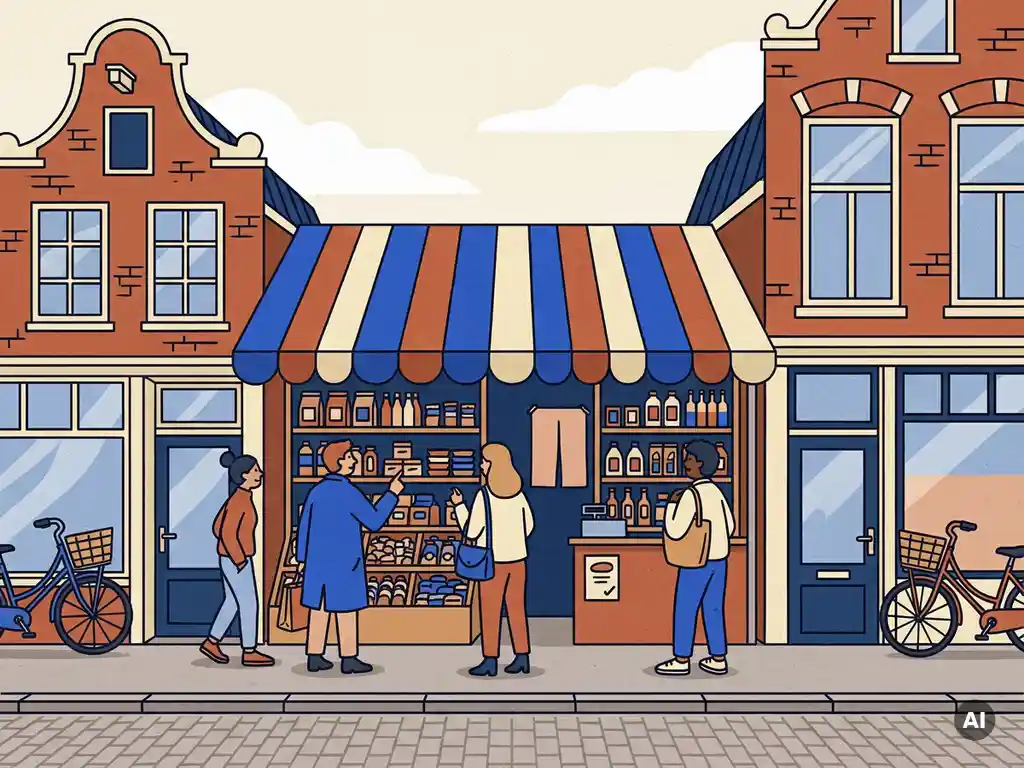
Testing a new retail location with a temporary pop-up works as follows: you rent a space for a limited period, from a few weeks to a couple of months, to measure whether the location suits your target audience before committing to a long-term lease. This is an effective approach for emerging retailers and e-commerce brands looking to make the move to physical retail without immediately taking on a multi-year commitment. The questions below help you set up a pop-up test step by step and translate the results into a well-considered location decision.
What are the advantages of a pop-up compared to a permanent store?
A pop-up store offers lower entry costs, shorter contract duration, and the freedom to experiment without long-term financial obligations. Where a permanent lease typically runs for five years, a temporary retail space allows you to determine within a few weeks whether a location actually works for your concept and target audience.
The benefits go beyond simply limiting financial risk. A pop-up allows you to observe customer behavior in a real retail environment, measure conversion rates, and test brand experience without being tied to a location that underperforms in hindsight. For e-commerce entrepreneurs considering the move to offline retail, this is particularly valuable: the data you collect provides insights that no web shop analysis can offer.
In addition, a temporary lease also offers tactical advantages when negotiating a permanent location. You already know the location from the inside, have proof of revenue and customer behavior, and are in a stronger position at the negotiating table than a tenant relying purely on expectations.
How long does a pop-up store need to be open to properly evaluate a location?
A pop-up store needs to be open for at least four to six weeks to collect reliable location data. Shorter periods introduce too much distortion due to the novelty effect and temporary attention. Six to twelve weeks is ideal: long enough to measure weekly patterns, seasonal effects, and returning customers, short enough to keep costs manageable.
The minimum duration also depends on your product category and the type of location. On a busy shopping street in a major city, clear patterns in foot traffic and conversion become visible after just four weeks. In a shopping center or at a less frequented location, you need more time to get a representative picture, especially if the location experiences seasonal traffic.
A common mistake is stopping too early because the first few weeks are disappointing. Customers need to discover your pop-up, and that takes time. Only after the third or fourth week does organic footfall begin to stabilize and can you truly interpret the figures.
What location data should you track during a pop-up?
During a pop-up store, you should track at minimum the following data: daily visitor numbers, conversion rate (visitors versus purchases), average spend per customer, peak hours and peak days, and the origin of customers. Together, these figures provide an objective picture of the commercial potential of the location.
In addition to the hard sales data, there are also qualitative signals that you should actively record:
- How easily do customers find the store? Do they walk there intentionally or discover you by chance?
- What are the most frequently asked questions or reactions from customers about the location itself?
- How does pedestrian traffic behave outside the door at different times of day?
- Which neighboring businesses attract customers who also visit your store?
Also note practical operational findings: accessibility for suppliers, parking facilities for customers, visibility from the street, and the quality of the premises itself. These are factors that, in a permanent lease, directly affect your day-to-day business operations.
Where can you find suitable spaces for a temporary pop-up in the Netherlands?
Suitable spaces for a temporary pop-up in the Netherlands can be found through specialized real estate agents, direct approaches to shopping center managers, vacancy management companies, and sometimes through platforms that facilitate short-term leases. The supply on public portals is limited and often shows already-let or less desirable locations.
The best locations for a pop-up store rarely become available online. Owners of prime locations on shopping streets and in shopping centers prefer permanent tenants, but during periods of vacancy or temporary availability are sometimes willing to offer a short-term contract. Those conversations take place through direct networks, not via Funda.
For retailers who want to seriously test at a quality location, it is advisable to engage a specialized retail agent. KroesePaternotte guides tenants in finding both temporary and permanent retail space throughout the Netherlands, including locations that are never publicly listed. That network makes the difference for a pop-up seeker between a mediocre and a strategically strong test location, from Amsterdam to Groningen.
What is included in a temporary lease for a pop-up store?
A temporary lease for a pop-up store contains agreements on the rental period, the rent per month or week, the condition of delivery, service charges, liability, and any restrictions on use. Because it is a short-term contract, it differs in several respects from a standard five-year commercial lease.
The most important legal nuance is that temporary rental in the Netherlands is in principle not possible under regular commercial tenancy law, unless the landlord invokes the so-called diplomat’s clause or another specific exemption provision. In practice, many pop-up contracts are drawn up as license agreements or as leases for other business space (Article 7:230a of the Dutch Civil Code), to which different tenant protection rules apply.
When signing a temporary contract, pay particular attention to:
- The exact start and end date and whether an extension option is included
- Who is responsible for fit-out, utility connections, and restoration upon departure
- Whether the rent is all-inclusive or whether service charges are added on top
- Which activities are permitted and whether you may alter the space
- The notice period if the landlord needs the space earlier
Always have a temporary lease reviewed by someone with knowledge of retail real estate before signing. The expertise of a specialized retail agent prevents you from agreeing to terms that prove disadvantageous in a later permanent lease.
When is a pop-up test sufficient evidence to rent a permanent location?
A pop-up test is sufficient evidence for a permanent location when you have consistent sales data over at least four to six weeks demonstrating that the revenue per square meter can structurally support the fixed rental costs, customer return visits are visible, and the operational experience has not raised any fundamental objections.
The rule of thumb is that monthly revenue during the pop-up should be at least ten percent above the expected permanent rent, taking into account the fact that a pop-up typically generates higher awareness than a new permanent store in its early stages. Conversely, if revenue during the pop-up is already disappointing, a permanent lease is a risk that is difficult to justify.
In addition to the financial figures, strategic certainty also counts. Have you tested the location in different seasons or market conditions? Do you know what the rent per square meter is compared to similar locations on the same street or in the same city? The latter is essential: a market-conform rent is not something you can read off from listings on portals.
KroesePaternotte holds lease contract data covering virtually the entire Dutch retail market, going back to 1984. That database makes it possible to quickly assess whether a requested rent is market-conform for a specific street, in any city. For a retail entrepreneur considering the step from pop-up to permanent store, that is the difference between a gut feeling and an informed decision. Contact KroesePaternotte to benchmark your location choice against current market data.
Related Articles
- How do you assess retail tenant quality in the Netherlands?
- How do you check if a retail property has been correctly valued?
- Why are more and more e-commerce brands still choosing a physical store?
- What are the risks of overhuurde retail property in the Netherlands?
- How do you combine a physical shop with an online shop at the same location?
- What is the Kalverstraat and why is it a prime retail street?
- What are the risks of expanding too quickly with multiple stores?
- When is a 303 valuation required for retail property?
- How do PDV and GDV locations work in the Netherlands?
- Renting a small retail space in the city center: what should you look out for?