
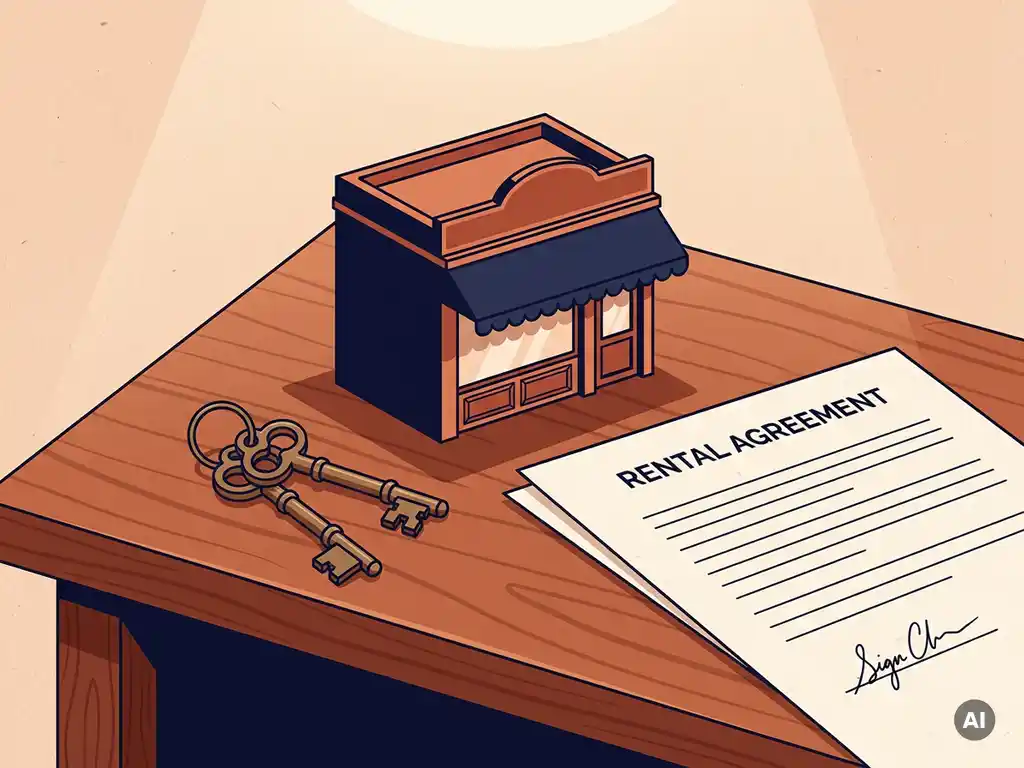
For most starting and growing retailers, renting is the smartest choice. Renting offers flexibility, requires less startup capital, and keeps funds available for investment in inventory, staff, and marketing. Buying can be attractive for established retailers with stable cash flow and a long-term vision for a single location, but for most entrepreneurs it is not a realistic or desirable starting point. The questions below help you determine which choice suits your situation.
What are the financial pros and cons of buying retail property?
Buying retail property means building equity in real estate instead of paying rent to an owner. The property can increase in value, you are not dependent on a landlord, and you can design the space entirely according to your own vision. For retailers with a long-term horizon at a single location, this can be financially attractive.
The downside is considerable. The purchase of retail real estate requires a large initial investment, supplemented by transfer tax, notary fees, and financing costs. That capital is then unavailable for the core activities of your business. Moreover, as an owner you bear all the risks: vacancy, depreciation, major maintenance, and the consequences of changing retail areas fall entirely on your account.
In the Dutch retail market, the value development of retail properties has also been uncertain in recent years. Locations that were considered solid ten years ago are now under pressure due to changing consumer behavior and the rise of e-commerce. Those who buy are placing a long-term bet on one specific location.
What are the pros and cons of renting retail space as a retailer?
Renting retail space as a retailer offers flexibility and a lower barrier to entry. You do not tie up large capital in real estate, can switch locations relatively easily if the market changes, and bear no ownership risk. For most retailers, especially in the start-up or growth phase, renting is therefore the most common and logical choice.
The disadvantages are also present. You are dependent on the landlord for lease renewals and rent adjustments. At a popular location, the rent can rise significantly upon renegotiation. And the space you fit out does not build up as equity.
Yet the advantages outweigh for most retailers. The freed-up capital can be deployed directly for growth: better fit-out, more inventory, a second location. Guidance when renting retail space also helps to limit the disadvantages, by negotiating favorable contract terms and selecting the right location based on current market data.
When is buying more advantageous than renting for a retailer?
Buying is more advantageous than renting when a retailer has a proven, stable concept, is certain of a specific location for the long term, and has sufficient capital to finance the purchase without burdening business operations. In practice, this often concerns established retailers with multiple locations or their own real estate strategy.
Concrete situations in which buying can make sense:
- You have been operating successfully at the same location for years and want certainty about the future of that property.
- You have the financial capacity to buy without affecting your working capital.
- The rent at the desired location is so high that the capital burden of a mortgage is lower.
- You want to purchase a property that you partly use yourself and partly rent out.
For starting retailers or entrepreneurs who are still growing, the opposite almost always applies: the flexibility of renting has more value than the security of ownership.
What lease terms should a retailer be aware of?
When entering into a lease agreement, a retailer should at minimum pay attention to the rent and indexation, the contract duration and renewal options, the notice periods, any break options, and the division of service charges and maintenance obligations. These terms largely determine how flexible and affordable the rental relationship is in the long term.
The most common pitfalls:
- Rent indexation: In the Netherlands, rents are typically indexed annually based on the consumer price index. With long-term contracts, this can add up.
- Contract duration: Retail space is often leased for five plus five years. This provides certainty, but also commitment. Negotiate break options if you want flexibility.
- Service charges: In addition to the base rent, you often pay service charges for shared maintenance, security, or marketing of a shopping center. These can be substantial.
- Maintenance division: Who is responsible for major maintenance, roof maintenance, or installations? This is stated in the contract and has significant financial consequences.
Many retailers sign a lease without fully understanding all the clauses. A specialized retail agent can review the contract and identify problem areas before you sign.
How do you determine what a market-conforming rent is per location?
A market-conforming rent for retail space depends on the location, the type of retail area, the floor area, the footfall frequency, and recent comparable transactions in the same street or shopping center. Without access to current transaction data, it is virtually impossible for an individual retailer to assess whether an asking rent is realistic.
Rents per square meter vary considerably. An A1 location in a major city commands a very different price than a B location in a medium-sized city. Even within a single street, prices per segment can differ significantly, depending on pedestrian flow direction, visibility, and proximity to anchor tenants.
KroesePaternotte has a database of lease contract data going back to 1984 and covering virtually the entire Dutch retail market. No other party has this overview. That data makes it possible to assess per street, per city, and per location type immediately whether an offer is market-conforming. That is the difference between negotiating based on instinct and negotiating based on facts.
Can a retail specialist help with the choice between buying and renting?
Yes, a specialized retail agent can help a retailer with both the strategic consideration between buying and renting and with the practical execution of the chosen route. A specialist knows the market, has access to non-public listings, and can objectively map out the financial consequences of both options based on current market data.
For most retailers, the added value of a specialist is greatest on the tenant side. The best retail locations in the Netherlands do not always end up on public portals such as Funda. Owners and developers prefer to work with parties they know and who understand their locations. A retail specialist with a broad network has access to that hidden supply.
In addition, guidance during negotiations is valuable. Many retailers feel uncertain when facing a professional landlord or real estate investor. A specialist negotiates based on market knowledge and represents exclusively the interest of the tenant, not that of the landlord.
KroesePaternotte guides retailers in finding retail space throughout the Netherlands, from the first search to the signing of the contract. Whether you are opening your first store in Utrecht, expanding to Groningen, or moving from a B location to an A location in Rotterdam: the combination of national coverage, niche expertise, and a unique database makes the difference. Get in touch to discuss what the right step is for your situation.
Related Articles
- What are fixed versus variable costs when renting retail space?
- Can you improve retail property returns by repositioning a Dutch asset?
- What causes retail vacancy on Dutch shopping streets?
- What is the difference between high street and shopping centre investment?
- What are typical cap rates for Dutch retail property?
- How does Dutch lease law affect retail real estate investors?