
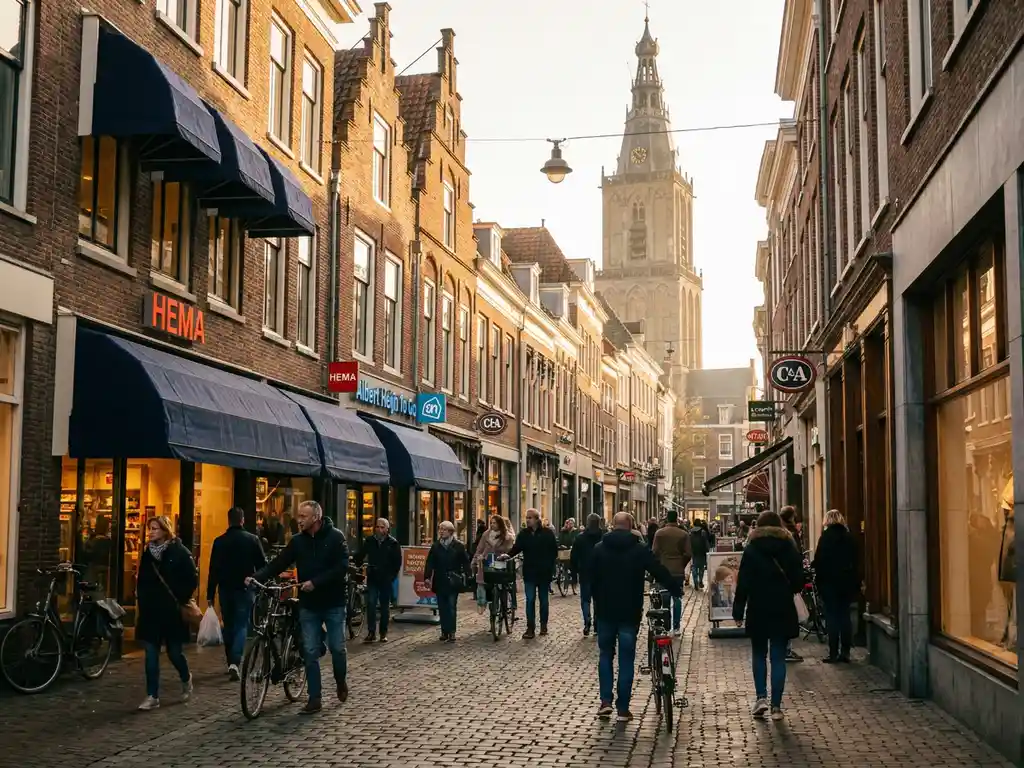
The strongest secondary retail cities in the Netherlands are Utrecht, Rotterdam, Den Haag, Eindhoven, and Groningen. These five cities consistently demonstrate the consumer catchment size, economic base, and retail infrastructure that institutional investors look for outside Amsterdam. Beyond this core group, cities such as Arnhem, Breda, and Tilburg are also attracting increased attention from investors who understand the Dutch retail market at a granular level. The sections below examine what qualifies these markets, how they perform on yield, and where investor interest is currently concentrating.
Which Dutch cities qualify as secondary retail markets?
In the Dutch retail real estate market, secondary cities are typically defined as urban retail centres with a regional catchment function, strong anchor tenants, and a recognisable high street, but without the liquidity depth or prime yield compression of Amsterdam. Utrecht, Rotterdam, Den Haag, Eindhoven, and Groningen are the most commonly cited secondary markets, each serving a distinct regional population base of several hundred thousand consumers.
What separates these cities from smaller tertiary locations is the presence of a proven retail core. Utrecht’s Lange Elisabethstraat and Steenweg, Rotterdam’s Lijnbaan and Koopgoot, Den Haag’s Spuistraat and Grote Marktstraat, Eindhoven’s Demer and Rechtestraat, and Groningen’s Herestraat all function as genuine A1 locations within their respective cities. International and national retailers actively seek space on these streets, which creates the tenant quality and lease continuity that underpin investable assets.
It is worth noting that the A1 versus B-location distinction is particularly consequential in the Netherlands. The performance gap between a prime pitch and a secondary street in the same city can be significant in terms of vacancy risk, rental sustainability, and long-term capital value. Investors working with KroesePaternotte’s retail research benefit from location-level intelligence that makes this distinction explicit rather than relying on city-level generalisations.
What makes a secondary Dutch retail city a strong investment location?
A strong secondary retail city in the Netherlands combines a stable consumer catchment, low structural vacancy on prime pitches, active retailer demand for space, and an economic base that supports sustained footfall. Cities where these factors align consistently outperform locations that look attractive on headline yield but carry underlying occupier risk.
Several specific indicators matter when evaluating secondary Dutch retail cities:
- Catchment population and spending power: Cities serving a regional population with above-average disposable income generate the consumer demand that keeps prime retail occupancy high.
- Retailer demand and waiting lists: In the strongest secondary cities, prime units rarely sit vacant. Retailer demand, tracked through active letting enquiries, is one of the most reliable forward indicators of location strength.
- Anchor tenant presence: Large format anchors, including department stores, supermarkets, and flagship fashion retailers, drive footfall that benefits surrounding units. The quality and lease term of anchor tenants are critical investment variables.
- Transport connectivity: Cities well-served by rail and road connections draw shoppers from a wider catchment, which supports both footfall volume and retailer willingness to pay market rent.
- Municipal retail policy: Dutch municipalities vary considerably in how actively they manage their retail core. Cities with clear inner-city retail strategies and planning controls that prevent peripheral dilution tend to protect prime pitch values more effectively.
Groningen is a useful illustration. Despite being the northernmost major Dutch city, it has maintained exceptionally low vacancy on its prime high street and continues to attract national and international retailers. That performance is not accidental. It reflects a combination of a large student population, strong regional catchment, and consistent municipal focus on the inner city.
How do secondary cities compare to Amsterdam for retail yields?
Secondary Dutch retail cities offer meaningfully higher net initial yields than Amsterdam’s prime high street, reflecting the liquidity premium that Amsterdam commands rather than a proportional difference in underlying income quality. Amsterdam’s Kalverstraat and PC Hooftstraat typically price at the tightest end of the Dutch yield spectrum, while prime pitches in Utrecht, Rotterdam, and Eindhoven trade at a spread above that level.
That yield gap is the core investment argument for secondary markets. An investor acquiring a well-let unit on a prime secondary high street can access stronger running income than an equivalent Amsterdam asset, while still benefiting from the structural resilience that comes with genuine A1 positioning in a regional centre. The risk is not the secondary city itself but rather the tendency of less experienced investors to conflate a secondary city with a secondary location, purchasing B-pitch assets at yields that do not adequately compensate for the occupier risk they carry.
Yield assessment in the Dutch market also requires understanding how lease structures affect income security. The standard Dutch retail lease runs for five years with renewal options, and rent indexation is typically linked to the consumer price index. Understanding whether a current passing rent is above or below market, and what a 303 rent review process could mean for income on renewal, is essential to any yield analysis. KroesePaternotte’s valuation and rent review advisory covers exactly this analysis, drawing on a lease database that spans virtually the entire Dutch retail market back to 1984.
What retail formats perform best in secondary Dutch cities?
In secondary Dutch retail cities, the formats that consistently perform best are prime high street retail units, standalone supermarkets, and well-anchored shopping centres with strong catchment exclusivity. Each format has a distinct investment profile, and performance varies depending on the specific city and location within it.
Prime high street units
On the strongest secondary high streets, prime units let to national and international fashion, health and beauty, and food and beverage retailers continue to demonstrate low vacancy and stable rental income. The key is genuine A1 positioning. Units on the primary pedestrian flow, adjacent to anchor retailers, in cities with active retailer demand, perform very differently from superficially similar units one street removed.
Standalone supermarkets
Supermarket investments have attracted significant institutional interest across the Netherlands, including in secondary cities, because they offer long lease terms, operationally essential tenants, and income that is relatively insulated from e-commerce pressure. The investment case depends heavily on the specific operator, lease structure, and whether the location has genuine catchment exclusivity or faces competitive exposure from nearby formats.
Shopping centres with strong anchors
Well-anchored regional shopping centres in secondary cities can offer attractive yields, but asset management intensity is higher than for high street investments. The quality of the anchor tenant, the lease expiry profile, and the centre’s competitive position within its catchment all require careful assessment. Centres that have successfully repositioned around food, leisure, and service tenants alongside fashion have generally held occupancy better than those dependent on a traditional retail mix.
How does Dutch lease law affect secondary retail investments?
Dutch lease law introduces several dynamics that international investors must understand before acquiring retail property in the Netherlands. The most significant is the market rent review mechanism under Article 7:303 of the Dutch Civil Code, which allows either landlord or tenant to request a rent adjustment to market level every five years. This process can work in either direction, meaning rents that are above market at review can be reduced, while below-market rents can be increased.
For investors in secondary cities, this has direct implications for income underwriting. An asset acquired with a passing rent above current market levels carries overhuurde risk: if the tenant exercises a 303 review, the landlord may be required to accept a lower rent on renewal. Conversely, assets where rents are below market offer genuine reversion potential, but realising that upside requires understanding what comparable market transactions actually support, not just what a vendor claims.
Indexation is the other key lease variable. Dutch retail leases typically include annual CPI indexation, which has provided meaningful rental income growth during periods of elevated inflation. Understanding how indexation interacts with the 303 review cycle is important for modelling realistic income trajectories over a hold period.
These are not abstract legal points. They directly affect whether an asset’s income is stable, growing, or at risk at the next lease event. Investors unfamiliar with Dutch lease mechanics benefit significantly from working with advisers who have transacted across the full cycle, as KroesePaternotte’s investment advisory team has done since 1984.
Which secondary retail cities in the Netherlands are growing in investor interest?
In 2026, Utrecht, Eindhoven, and Groningen are the secondary Dutch retail cities attracting the most active investor interest. Utrecht benefits from its central position in the Dutch rail network and a large, affluent consumer base. Eindhoven has seen consistent retailer demand growth driven by its technology and design economy, which supports strong spending power in its catchment. Groningen continues to demonstrate the structural retail resilience that has made it a consistent performer for long-term investors.
Rotterdam is also seeing renewed attention, particularly for assets in and around its prime retail core, as the city’s ongoing urban development has strengthened its retail appeal. Den Haag remains relevant, though its retail market is more nuanced, with performance varying more sharply between prime and secondary pitches than in some of the other major cities.
The broader context is that Dutch retail investment volumes rose significantly in 2025, and the pipeline for 2026 reflects continued appetite from both domestic and international capital. However, the supply of genuinely investable assets in strong locations remains limited. That scarcity dynamic means that investors who can identify and transact on quality assets quickly, with the market intelligence to price them correctly, are at a structural advantage over those relying on publicly available information alone.
For international fund managers evaluating the Dutch retail market as part of a European portfolio strategy, the combination of a transparent legal framework, stable consumer fundamentals, and a yield premium over core European markets makes secondary Dutch cities a credible allocation. The complexity lies in execution: knowing which specific assets, in which specific locations, at which specific price points represent genuine value. That is precisely where a specialist with four decades of active Dutch retail market presence provides an edge that generalist brokers cannot replicate. KroesePaternotte advises investors across the full transaction cycle, from acquisition search through to disposal, with live market intelligence drawn from simultaneous activity in leasing, valuation, and investment across all major Dutch retail cities.
Related Articles
- How does Utrecht compare to Amsterdam for retail investment?
- What drives rental income on retail property in the Netherlands?
- What is the difference between an A1 and B-location in Dutch retail?
This content was generated with the help of AI — it may contain mistakes